
I recently visited New Orleans for the first time and was treated to the “Big Easy’s” famously charismatic culture, known worldwide for its unique blend of French, Spanish, African, and Caribbean themes.
Some say every major US city has a “culture.” However, in most cases this merely means the particular stage of anarcho-lib degradation it is in—from moderate (Boston, Dallas, etc.) to advanced (Portland, San Francisco, etc.)—or with what accent a belligerent stranger accosts you in the street (ah, was that a New York or Chicago?).
In most places, the homogenizing forces of industry and architectural trends that favor form over beauty have robbed places of anything but a superficial “identity” that can usually be boiled down to some superfluous identifier. (I.e., Philadelphia = glass & concrete but with cheesesteaks; Milwaukee = glass & concrete but with cheese curds.)
To be truly cultural, a place should have characteristics that meaningfully distinguish it from someplace else. New Orleans fits this definition. Its architecture, food, music, and spirit all stand out as its own. Its sense of place is turned up to maximum.
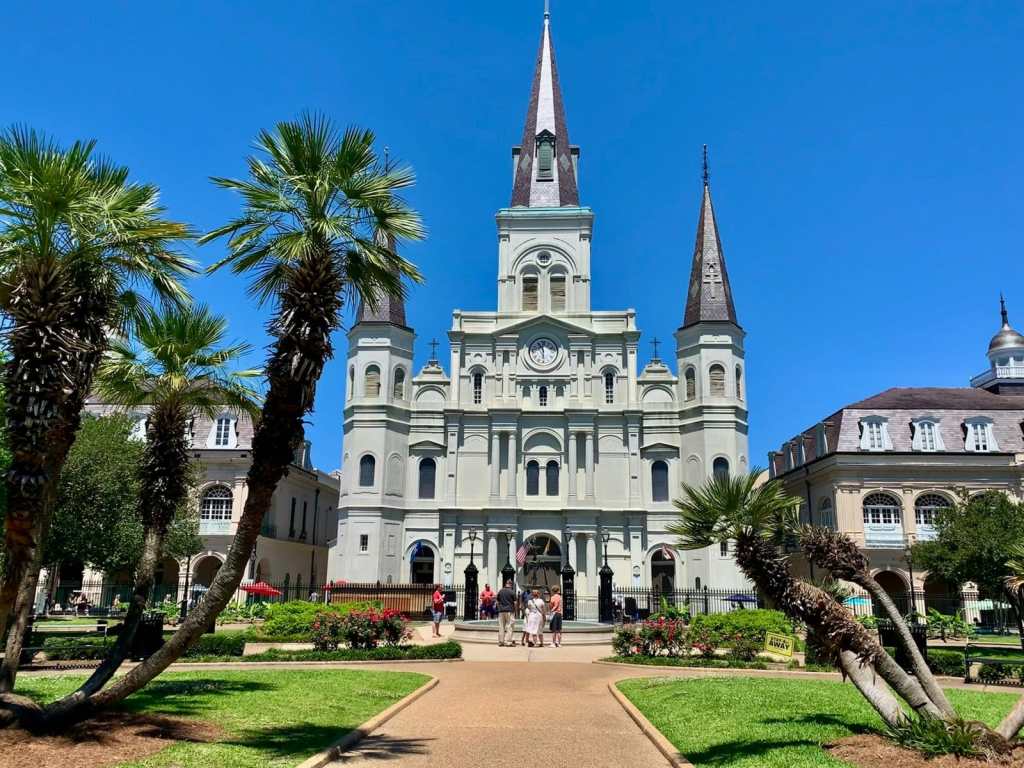
It is tragic, then, that while New Orleans has escaped the culturally homogenizing forces of liberalism and industrialism, these modern antagonists have struck it in another, perhaps even more crippling way: by severing its bonds with the ecosystem that sustains it.
Ever since the days of Francis Bacon, a key tenet of the liberal philosophy has been the supremacy of man over nature and the fetish-like desire to bend the natural world to his will for ease and efficiency. From its very beginning, New Orleans swallowed this tragic ideology whole and has vainly sought mastery over the Mississippi River Delta in almost every conceivable way.
Coastal ecosystems are sustained by a delicate balance of erosion and sedimentation. In Louisiana, the Mississippi River is a massive land-building engine that carries sediment from the vast interior of the continent to the coast. Being a river, the Mississippi’s boundaries are never fixed for long, and its channel has meandered over eons. But by wishing to live above and not within this natural reality, the early inhabitants of New Orleans, and later the US Government, sought foolishly to overcome the river with devastating results.
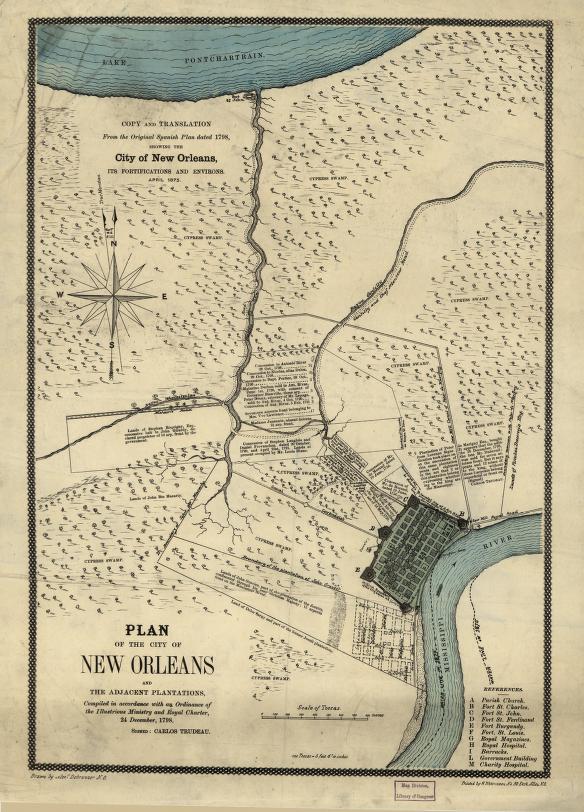
A late-18th century map of New Orleans and its surrounding plantations (Source: Library of Congress)
In the early 18th century, the city’s first settlers occupied a small, elevated ridge adjacent to the river (today’s French Quarter). Not content with this meager amount of land, thousands of acres of swamps and marshland were drained. This accelerated after the 1803 Louisiana Purchase and the sudden introduction of American capitalism to the unsuspecting French parish.
To protect these new below-sea-level lands (and more importantly, their economic interests), the US Government was more than willing to build what would eventually be 4,000 miles of levees imprisoning the entire Lower Mississippi. Its route would now be forever fixed, never to meander again.
Yet the river fought against its chains, and a critical section began to shift southward toward the outlet of the Atchafalaya. But as the city grew and increasingly relied on a reliable path for shipping, this simply would not do. So, in 1963 the Army Corps of Engineers decided to build a structure that would prevent the river from moving where its natural topography would take it and force it to continue past the Port of New Orleans.
Still not satisfied with the existing (now locked-in) path of the Mississippi River, and to save the shipping companies a few hours of travel, in 1968 the Army Corps blasted through 76 miles of cypress swamp forest to create the perfectly straight Mississippi River-Gulf Outlet (MRGO). MRGO immediately became a superhighway for oceanic saltwater, leading to a complete collapse of the cypress ecosystem. Its channel also led Hurricane Katrina’s storm surge to the city’s back door and was directly responsible for most of the city’s flooding.
By imprisoning the river that once sustained it in engineered chains, New Orleans has forced itself into a spiraling mess inescapable but for greater human intervention. The Army Corps’ latest salvo, the Lake Borgne Storm Surge Barrier, is a 2-mile long, 26-foot-high monolith intended to mitigate the disastrous effects of MRGO. While built to prevent the devastation of another Katrina, the barrier transforms the city’s relaxing marshy outskirts into something akin to cold-war era Berlin. The looming wall tacitly instills an antagonism with the outside world in the mind of New Orleans’ residents, as if they are under siege.

The Lake Borgne Storm Surge Barrier
These engineering projects have collectively transformed the Mississippi from the world’s largest sediment mover to a neutered, channelized skeleton. Unlike literally every other river in the world, the Mississippi no longer has a delta to call its own. Its marshes, starved of sediment, appear pocketed and shriveled from the air as if literally rotting away.
Today, the present Louisiana administration has cancelled major investments to return some degree of natural deltaic flow and marsh-building sediment to the Lower Mississippi, citing short-term economic concerns of the region’s fisheries. As the only projects that could realistically raise the elevation of the land surrounding the sinking city, the fisheries may soon no longer have habitat from which to rase the fish, or residents to fish for them.
The spirit of modernity has spared New Orleans’ soul but dealt its body a perhaps mortal blow. New Orleans is a city that desperately wishes—and deserves—to stay alive, but by tearing asunder the living, self-reinforcing system that built its lands, it is barely treading water. Only by living within the natural functions of the Mississippi River and restoring the equilibrium that sustained the surrounding delta for millennia, does New Orleans stand a chance of physical survival.
By Evan Patrohay
 Thoughts of an Environmental Conservative
Leave a comment