
We the People of the United States, in Order to form a more perfect Union, establish Justice, insure domestic Tranquility, provide for the common defence, promote the general Welfare, and secure the Blessings of Liberty to ourselves and our Posterity, do ordain and establish this Constitution for the United States of America.
Like the introduction at the beginning of any good novel, the Preamble to the US Constitution laid out the purposes of the government that was just then being formed. Like the mission statement written at the founding of a company, it was intended to provide a high-level guide to the generations that followed, so that they never forgot what the new US government was “all about.”
The Preamble, from its very first words, holds the US populace as a coherent People. Each of its stated purposes is for the benefit of a Whole. The new government is meant to ensure domestic tranquility, promote the common defense, provide for the general welfare. In other words, the Constitution provides a distinct vision of the common good.
Yet, today’s “common good,” wherever the phrase still happens to be used, appears a lot less “common.” Nowadays, “ensure domestic tranquility” simply means “just make sure that other guy’s freedoms don’t impact my own.” The outward and upward vision laid down by the Preamble has narrowed, turning inward and downward into a merely private sphere. The common good is no longer considered from the perspective of a People, but has simply become “leave me the hell alone.”
But it is impossible to form a society out of millions of individuals who want to be left alone. The word “society” stems from the Latin word for “fellowship” (societas). To have a society of atomized individuals is to have an oxymoron.
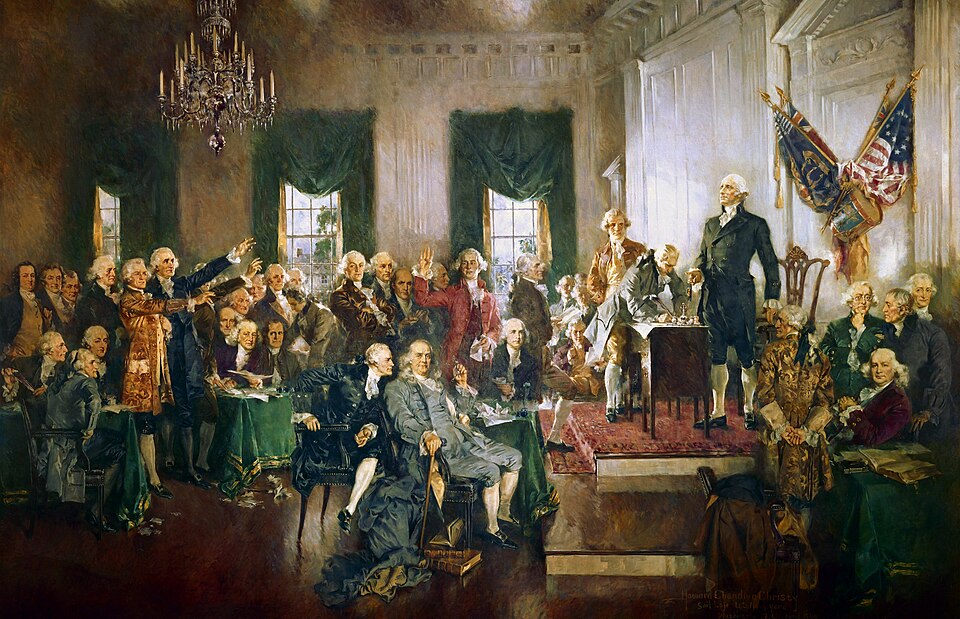
Scene at the Signing of the Constitution of the United States (1940) by Howard Chandler Christy
If a society is held in common, then the common good is what all in that society ought to be ordered to. It gives a society its direction and is the standard by which it can be judged (as the Preamble succinctly demonstrates). Yet, the arrogant Enlightenment liberalism that stained our founding inverted this order–now, the government was to be ordered to the freedom of the individual, with the “common good” a thing that emanates from it.
This is because, over the course of the Enlightenment, most infamously stemming from thinkers like Smith and Mandeville, it began to be believed that a flourishing order could be derived from the “selfish” ambitions (or vices, to use Mandeville’s term) of individuals. Individual liberty soon became the ultimate principle by which the good of a society could be derived.
Russell Kirk once wrote that the “ruinous failing of the libertarians” was their “fanatic attachment to a simple solitary principle–that is, to the notion of personal freedom as the whole end of the civil social order, and indeed of human existence.”
Suffice it to say, that the vision outlined in the Preamble cannot so simply be achieved from such a solitary principle. It requires the balancing of the several principles listed, which are in competition by the very fact that they are catalogued (domestic tranquility and common defense are two principles often in tension, for example). It is an eternal truth that stability is produced by forces placed into tension, while unstable feedback loops are produced when a single force gains supremacy, and societies are no different. Hence, the unworkability of individual liberty as a single rule.
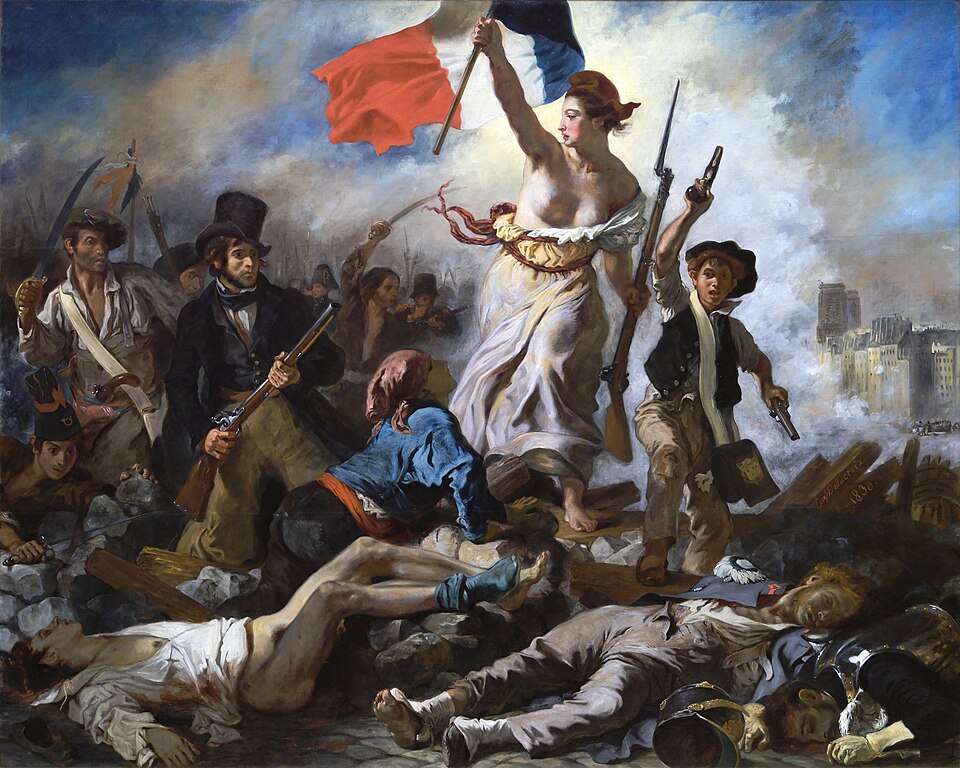
Liberty Leading the People (1830) by Eugene Delacroix
Though the Founders structured their government with a vision towards a series of principles that would collectively entail the common good, the selfish “spirit of liberty” of the Enlightenment ultimately won the day, and has accelerated in the modern era as the moral vestiges of the Founding era have faded.
Yet, the United States still retains a structure conducive to the common good. Our Founders were wise enough to place our government in tension, filled with “checks and balances” and “ambitions that counteract ambitions.” But structure means little if the proper spirit is not present to direct its engines toward the correct order.
Therefore, it is up to the American people to remember they are a People again, and cast individual liberty off its pedestal–rather placing it in balance with the other competing principles where it is meant to be.
By Evan Patrohay



Leave a Reply