
On this, the week following the 800th anniversary of the Feast Day of Saint Francis of Assisi, let us take special care and strive to live in harmony with the creatures of this world.
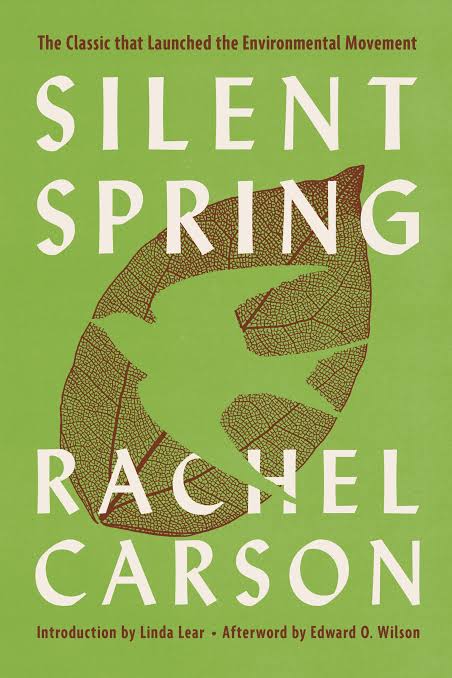
I will admit, I broke late into Rachel Carson’s landmark Silent Spring, the book considered to be the origin of the conservation movement, for one who has considered himself a conservationist for many years now.
Given the fits of emotion the movement is liable to, I expected the book to likewise be emotional. I thought it would contain more of the surface-level nostalgia that wins the complaints of the many critics who lie outside the movement. But I was sorely mistaken. Carson’s work resounds with a matter-of-fact and resolute, often scientific, force. She, recounting the at times unimaginable escapades of government bureaus and laymen alike, tells things as they are.
And sprinkled within are written gems of wisdom that sparkle amidst the otherwise stomach-turning tales she tells, similar to the emeralds, rubies and sapphires of Aldo Leopold or Wendell Berry. She writes of:
“Agriculture as an engineer might conceive it to be. Nature has introduced greater variety into the landscape, but man has displayed a passion for simplifying it. Thus he undoes the built-in checks and balances by which nature holds the species within bounds.”
And:
“As man proceeds toward his announced goal of the conquest of nature, he has written a depressing record of destruction, directed not only against the earth he inhabits but against the life that shares it with him…The question is whether any civilization can wage relentless war on life without destroying itself, and without losing the right to be called civilized.”
There is a strong tendency today for the uninformed to believe that “things are better now.” That most foods we eat and chemicals we juxtapose ourselves with are safer than in Carson’s time. That the governments and corporations regulating these things are more trustworthy. (“They would never sell these if they knew it would hurt us!”)
In the introduction of her book, Carson wrote “there is still very limited awareness of the nature of the [chemical] threat.” And this unfortunately remains overwhelmingly true today. Bugs no longer cloud our windshields during road trips as they did in our youth, and we acknowledge this, chuckle, and move on as if this fact were as normal as the gas stations and sleepy towns we zoom by. Agricultural Iowa has one of the highest cancer rates in the country, and we call it a coincidence.
Studies show that half of US waterways are too impaired to swim and 150 million Americans routinely breathe unclean air, even 50 years after the nationwide environmental laws that Carson’s legacy helped enact. PFAS chemicals, which are so toxic they are measured in parts per trillion, are laden on the packaging of the food we eat and the cookware that food is prepared with. Almost 200 million Americans are served by drinking water systems known to contain some level of PFAS and all of us have measurable amounts in our blood. This is not even to mention the burden of microplastics, which the entire human body has become replete with.
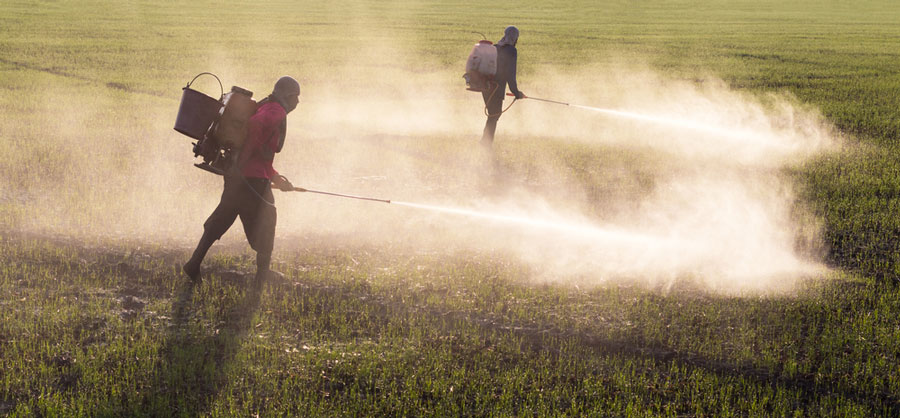
Furthermore, the onslaught of pesticide spraying, what Carson called “[beating] plowshares into spray guns,” has not ceased. Neonicotinoids, a substance I have written on before, is acutely toxic to pollinating insects, is a suspected culprit of widespread fish and bird kills, and is applied on the order of 4 million pounds annually. Glyphosate, a controversial (household) chemical oft in the news, is sprayed on some crops before harvest to dry them out, blatantly increasing the chances they show up in food.
Facetiously detailing our strange and growing intimacy with unnatural chemicals, Carson once wrote, “Our attitude toward poisons has undergone a subtle change. Once they were kept in containers marked with skull and crossbones; the infrequent occasions of their use were marked with utmost care…[now they are] with the pickles and olives across the aisle and the bath and laundry soaps adjoining.”
Carson compared the “innumerable small-scale exposures to which we are subjected day by day, year after year” to the “constant dripping of water that in turn wears away the hardest stone.” And this stone–our health–is undoubtedly eroding. Several cancers in both children and young adults are on a multi-decade rise, some sharply. Alarmingly, incidences in younger individuals make toxin exposure a more likely culprit.
So clearly, if anything, the intimacy which Carson ridiculed has only grown. This makes the dichotomy between some sillier pop-culture fixations (gluten, anyone?) versus the chemicals we willingly ingest every day something that puts a new (and literal) perspective on Christ’s words: “straining out a gnat but swallowing a camel.”
Carson wrote, “seldom if ever does Nature operate in closed and separate compartments,” a thing we have borne witness to this from the days of Silent Spring to the present. Of the poisons we surround ourselves with, nature bears the brunt. Animal populations have starkly declined for decades, many which first began plummeting in the era of which Carson writes.
The World Wildlife Fund estimates that wildlife populations have declined by 69% in the past 50 years. There has been a documented loss of three billion birds during the same time period. Amphibian populations are declining at almost 4% a year.
If our bank account was doing the same, we would stop at no cost to change our investments and salvage our portfolio. So why, when we have been placed in a position of stewardship over the greatest treasures known to man, do we look the other way?
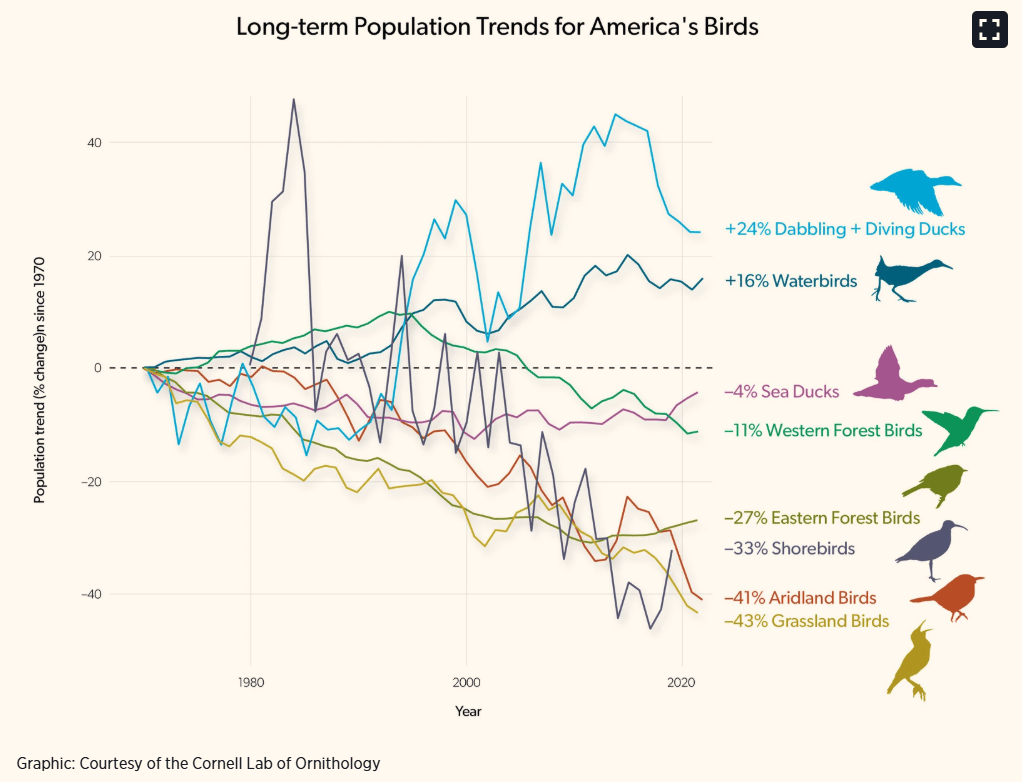
Chart depicting avian decline. Sourced from the National Audubon Society. Graphic made by the Cornell Lab of Ornithology.
It is plain from both Scripture and mere observation that things that are true beget life. “I am the Way, the Truth, and the Life” (Christ, speaking in John 14:6). “The words I speak to you are spirit–and they are life” (Christ, speaking in John 6:63). Therefore, as we have wrought so much death over the world, it is plain that we are not living in a truthful, righteous way.
It is time to once more restore harmony between us and the natural world, to the degree possible in this fallen world. We must utterly reject the centuries of “improve[ment] on nature’s way” and our “giddy sense of power over nature” (both Carson’s words).
For at every turn, Carson calmly shows how the use of natural means to solve environmental problems–what we would today call nature-based solutions–work magnitudes more accurately than any of the brutal, haphazard, chemical-laden methods she recounts. Rapid isolation of elm trees showing symptoms of disease in New York City, control of the invasive Klamath weed using introduced beetles, suppression of the gypsy moth using parasites and predators. In every example, Carson proves how reliance on chemical “solutions” makes original problems worse. (Though, interestingly, she is an advocate for biological control–which I am much more cautious of.)
The best medicines work with the body and not against it. Therefore, the best way to solve the environmental problems of today, most of our own creation, is to reject our arrogance at overcoming the natural by rejecting once and for all the multitudinous poisons unseen that surround us. Let us hurry, while there is still breath in our lungs and living creatures for us to steward.


Leave a comment