
To the modern man there is only one means of achieving order: that of the scientific. Thinking that nature is an unruly force to be tamed, he has forgotten that more ancient and original means of organization: the organic, which by being natural obeys an order of its own—the Natural Law.
I reflected upon this while walking the historic and richly beautiful canals of Amsterdam early one morning, before my mind became more occupied with dodging eager bikers and ambivalent pedestrians. Amsterdam is renowned for the homes that line its canals, each distinct yet coherent with its neighbors. Today, the historic parts of Amsterdam look much the same as they did 400 years prior, only with more Palestinian flags in the windows.

The picturesque streets of Amsterdam
There is no other city like Amsterdam, for the Dutch masterpiece arose organically over centuries, making it is automatically its own. But when most modern people hear the word “organic” their mind nervously thinks “anarchy.” Assuming there is no order beyond the mathematical, they claim that to avoid chaos a city must be planned according to the order of science, complete with multi-million-dollar studies and high-brow architects.
But Amsterdam, I can assure you, is highly ordered, as much as the bikes and narrow streets may take getting used to if you are an American. This is because the city was pieced together over time not by a far-away architect but by the community itself. As Amsterdam grew, its people, in communion over generations, collectively agreed and disagreed as to what was right according to the nature and needs of their society.
A community in any true sense of the word is ordered because it is natural, as biological life cannot exist without order. Life, after all, does not arise from a mass of molecules but molecules arranged into tissues and organs and so forth. Communities that grow organically will therefore possess an order shaped by their specific duties and obligations, what I here call the Natural Law. And any city which arises from such a community will thus obey the order of that community. This should come as no surprise, as organic and organize stem from the same root word.
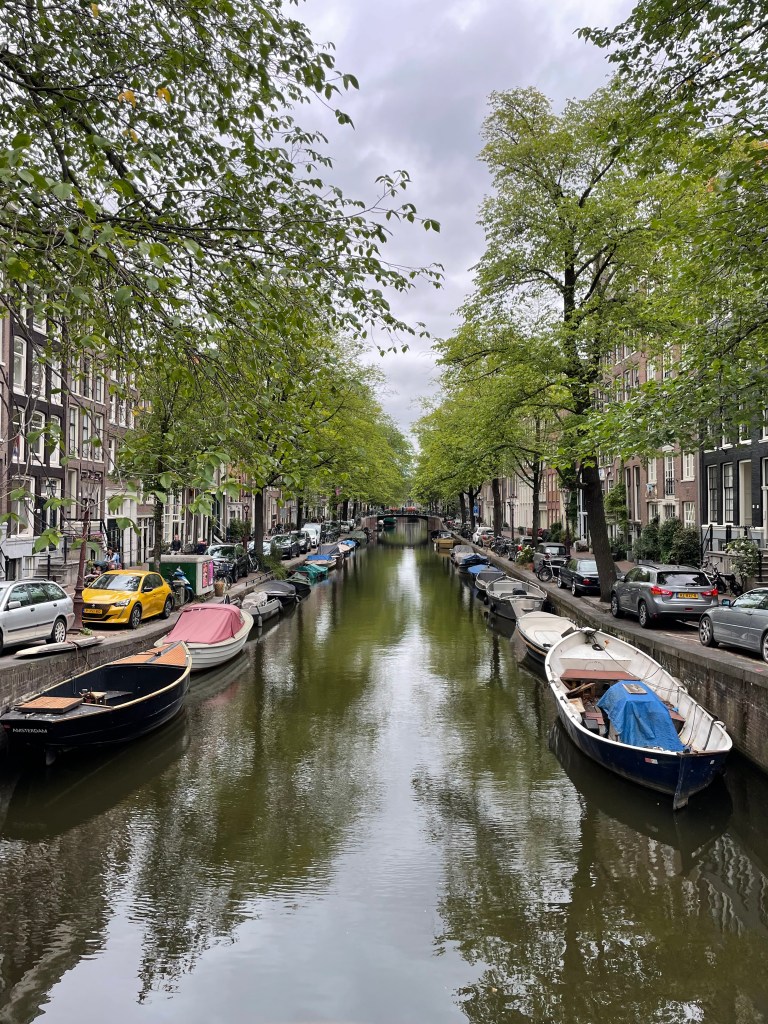
It is hard to take a picture of Amsterdam that is NOT photogenic.
In 2009, Elinor Ostrom won a Nobel prize for her 1990 work Governing the Commons, which proved empirically that a healthy community could indeed appropriately organize itself and steward its resources. In other words, “organic,” containing the root word for “life,” begets a livable, enjoyable, experience in a city.
The same cannot be said for artificial development, done according to science, which makes the city operate more like a high school math class. A city that doesn’t follow the order of nature is like a woman who’s “had some work done.” Things that are false subtract beauty, even when established with the intention of advancing it. When things are made artificially, well…you can always tell.
Scientific planning is that of the uniform. It lacks imagination by definition. As Chesterton wrote, “you cannot imagine two and one not making three.” The modern scientific planner is like your control-freak boss at work. He thinks that if he does not control the business process at every stage, then the work will not get done appropriately. When we all know the opposite is the case: his overbearing presence is stifling.
Organic planning is that of unity. It provides a framework within which to operate but allows for coherent diversity. (To quote Chesterton again: “the essence of every picture is the frame”). It is like a forest, itself organic. Though full of countless species, it is coherent within itself. The forest is all green, yes, but look closely at the astounding range of shades of that color!
Scientific planning is that of the uniform…organic planning is that of unity.
Nearly every modern ill can be traced to this one factor: modern man, who has broken his communion with the Natural Law and “gone his own way,” is afraid of what will happen when he relinquishes control. He has forgotten that there is an order that undergirds his own. One that would strengthen and breathe life into his own if only he were to obey it.
The truth of this is evident in the very language we use. We speak much of community these days. Well, “comm-unity” combines both communion and unity, neither of which is achievable through the rigidity of science.
So it is time for us to meet our neighbors, love them, and build with them according to the common good, which cannot be calculated as if according to a mathematical formula but worked out in the here and now, navigated through our duties and obligations with each other and illumined by objective truth.
By Evan Patrohay

 Thoughts of an Environmental Conservative
Leave a comment