
In June of 2024, a hiker made a disturbing discovery after trekking deep into the Yuntai Mountain Geopark, a grand 556 km2 UNESCO designated natural park nestled in the southern foothills of the Taihangshan Mountains, which straddle the border between the Henan and Shanxi provinces of northern China.
On his journey, the hiker passed several of the park’s geological wonders: stunningly rugged karst formations protruding like rounded stone columns above the landscape, their tops artfully swaddled by the park’s characteristically misty clouds; miles of winding clear-blue waters fed by the park’s countless freshwater springs, the very force which molded such stunning and rocky formations and ate away their soft limestone casings over eons; and many a waterfall, all which noisily stake their claim as the masters of the park—and its largest tourist draw.

The Yuntai Mountain Waterfall, Yuntai Mountain Net
Eventually, the hiker arrived at the grandest waterfall of them all: Yuntai Mountain Falls, which at 312 meters is pronounced as the tallest uninterrupted waterfall in China. Of the adventurous sort, the hiker decided to climb to the top of its dizzying cliff and survey the park from above. Only when he reached the very top did he realize something was wrong.
The waterfall was being fed by a pipe.
Ever since the modern environmental movement came into force in the 1970s, one swirling debate has raged: which is better for the environment, capitalism or socialism?
This debate has become more acute in recent years, with proposals of Green New Deals and outright denials of environmental issues caricatured as the extremes of both sides. The predominant environmental narrative of today, which is largely crafted by the political left, frequently suggests that it is socialism, with its utopian togetherness and heroic self-denial, and not capitalism, with its profit motive and widespread greed, that will lead us to the green promised land.

For instance, Alexandria Ocasio-Cortez, chief proponent of the Green New Deal, has called capitalism an “irredeemable system” which is singularly driven by, quote, “the absolute pursuit of profit at all human, environmental, and social cost.”
Rep. Alexandria Ocasio-Cortez, Jemal Countess, Getty Images
Therefore, with AOC at the Green New Deal’s helm it is no surprise that, in the words of NPR: “the Green New Deal framework combines big climate-change-related ideas with a wish list of progressive economic proposals that, taken together, would touch nearly every American and overhaul the economy.”
To uncover which economic framework is best, we must examine the environmental records of both capitalistic and socialistic countries. For the environmental intentions of each may be noble, but results are undeniable.
The Environmental Legacy of Socialist Nations
Socialist nations, to put it bluntly, have a terribly poor environmental history.
The destructiveness of the Soviet Union has been well captured in Australian philosopher Arran Gare’s The Environmental Record of the Soviet Union, and its sheer magnitude cannot be overstated. According to a 1990 report, the USSR lost one million hectares of cultivated land per year to poor farming practices, dust storms, and changes to the water table. The nation also lost more agricultural land to radioactive contamination—through illegal dumping, storage facility explosions, and Chernobyl—than the entire farmable area of Switzerland. Furthermore, more land was flooded by hydroelectric dams than the total area of the Netherlands.
By excessive damming the Soviets destroyed the immense Aral Sea in a matter of decades. The runaway desertification this caused, and the years of toxic pesticides and fertilizers which settled into its now dry lakebed, has caused millions of tons of salt and toxic particles to blow across the surrounding region, leading to more lost land. The lake, once the world’s fourth largest, is rarely still depicted on maps.
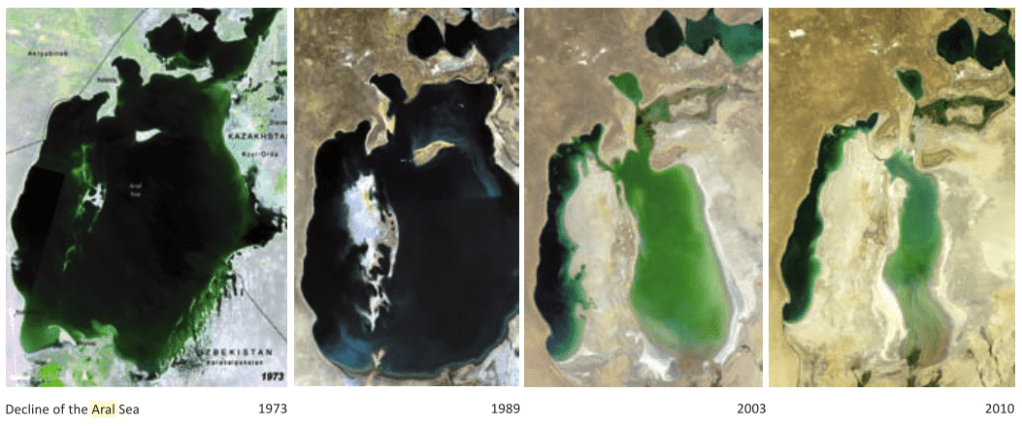
Decline of the Aral Sea over time, Global Atlas of Environmental Justice
Though the Soviet Union has long since passed, Russian pollution is still amongst the worst in the world. Even in supposedly pristine Siberia, satellite imagery has captured its rivers turning red on multiple occasions, the result of illegal chemical discharges. According to the New York Times, one of the plants responsible for these discharges is surrounded by a dead zone “twice the size of Rhode Island.”
In Communist China, artificially fed waterfalls are the least of their concerns. Likewise plagued by poor farming practices, the nation is suffering from an acute water scarcity. Northern China is home to two-thirds of its farmland and 43% of its population, but only 14% of its water supply. Both surface and groundwater have been severely overused, causing China’s aquifers to drop by three meters a year and the Yellow River to dry up every year since 1985. The northern Hebei Province has stunningly lost 969 of its 1,052 lakes.
According to the US State Department: “Beijing is the world’s largest emitter of greenhouse gases; the largest source of marine debris; the worst perpetrators of illegal, unreported, and unregulated (IUU) fishing; and the world’s largest consumer of trafficked wildlife and timber products.”
Chinese pollution, meanwhile, is infamous as one of the worst in the world. Over 30% of China’s land area still suffers from acid rain, a problem the United States and Europe solved decades ago through an emissions-trading market. According to the World Health Organization, air pollution is responsible for two million deaths in China per year, nearly half the population of my home state of South Carolina.
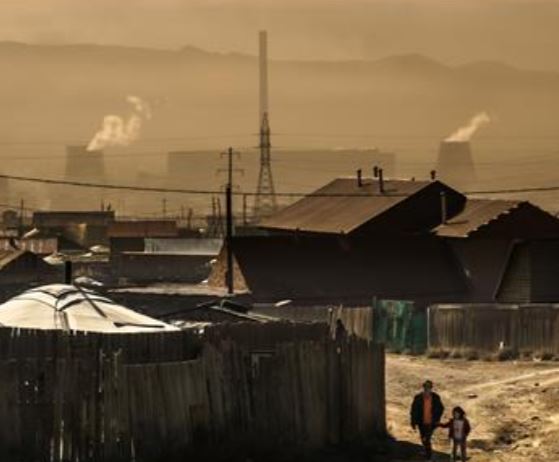
Furthermore, Chinese greenhouse gas emissions increased 80% between 2005-2019, while in the United States they decreased by over 15% over the same time period. These increasing emissions counteract the progress of other nations around the world in reducing global carbon outputs.
Air pollution in rural China, WHO, Y. Shimizu
Even the “Scandinavian-socialist” countries, including Norway and Finland, have some of the highest emissions per capita in Europe, though they possess a culture of exceptionally strong environmental regulations.
Certainly, history shows that socialism is not the fabled utopian environmental solution it is played up to be. In fact, in its most severe cases, it has proven to be the opposite.
The Environmental Legacy of Capitalist Nations
Meanwhile, the modern history of capitalist nations has displayed far more favorable outcomes.
Since 1990, the United States has decreased its nitrous oxide emissions by 5%, methane emissions by 19%, and fluorinated gases by 58%. The United States has reduced CO2 emissions by nearly 20% since 2005, with reductions predominantly concentrated within the electric power sector, itself mostly driven by a 60% increase in natural gas production. Furthermore, though its per capita emissions remains amongst the highest in the world, they too have decreased by 30% since 1990.
While environmental regulations in the United States have risen and fallen in strength over time, at no point has there been a need for a socialistic planned economy. All these reductions occurred under the continuing tenure of a combination market forces and government incentives.
Furthermore, unlike most socialist regimes, capitalist democracies are strongly supported by the rule of law. Laws like the Clean Air Act and Clean Water Act continue to have a transformative impact on the American environment. For instance, according to the EPA, since 1990 national concentrations of air pollutants improved 73% for carbon monoxide, 61% for annual nitrogen dioxide, 25% for ozone, and 91% for sulfur dioxide. Lead has also decreased 86% since 2010. Even when considering the controversial Sackett Supreme Court decision which eliminated non-hydrologically connected wetlands from federal protection, environmental damage in the United States pales in comparison to that of socialistic nations both past and present.
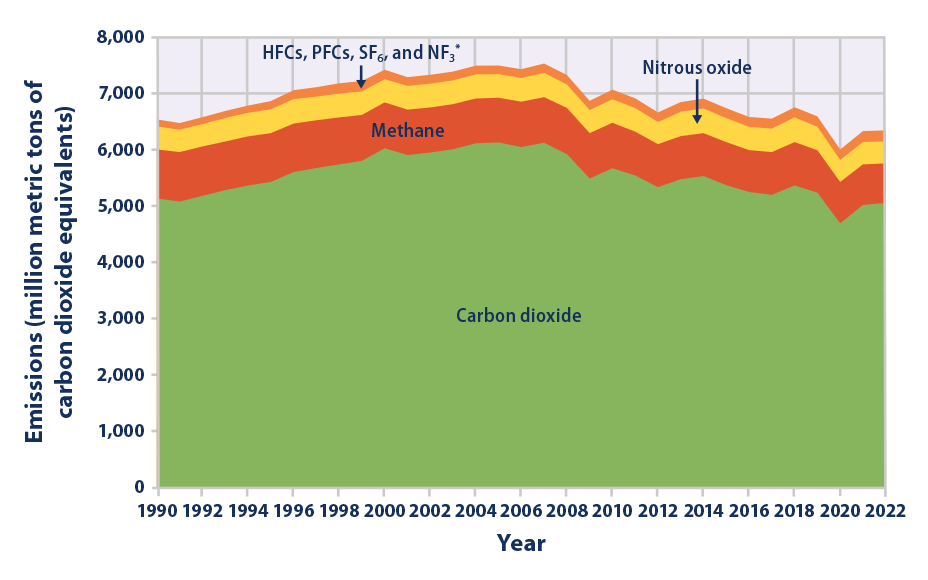
US greenhouse gas emissions 1990-2022, US Environmental Protection Agency
Meanwhile, the European Union has established a market-based emissions cap and trade program to achieve similarly excellent reductions. The European Commission, for instance, reported that EU member states reduced emissions by over 15% from 2022-2023 alone. This has placed the bloc’s emissions at 47% below their 2005 levels.
Clearly, then, capitalist nations have recently had remarkable and rapid conservation success across the globe.
Why Socialism Causes Harm to the Environment
Socialism harms rather than protects the environment for one reason only: it is inherently against nature. Human nature, societal nature, and ecological nature.
Socialism is against human nature because it is a reductionist philosophy that discards the uniqueness of the individual for a class-based view. Under this ideology, man is meant to “overcome” his natural tendencies for private property and self-interest in favor of the abstract collective. An impossibility.
Socialism is against societal nature because it is not possible, prudent, nor ethical to fully plan every intricacy of a people and nation. Such an act destroys individual sovereignty, and the consequences of this have been well documented in the widespread death and suffering of the Stalinist and Maoist regimes.

1957 Soviet propgaganda poster, Artist B. Berezovskiy
Ironically, though socialist environmentalists may lament that capitalism fails the environment because it is industrial and production-based, with a need for an ever-growing economy, socialist ideology also necessitates production and growth. The Soviets and Chinese sought to bring their products to market and grow their industry just as much as capitalist nations. They just did so with different people in charge. Therefore, socialism does not escape this essential criticism.
And, most importantly for our purposes, socialism is against ecological nature because it seeks to remake the natural world in its own image. Socialism is an inherently atheistic ideology. It claims that mankind, and mankind alone can solve its problems by reinventing itself and changing every aspect of its culture and society. Socialist leaders are keenly aware of the impossibility of this, and it has made them insecure. Therefore, unable to transform human nature as they wished, they turned their efforts to transforming the natural world. Man would become God.
Socialism harms rather than protects the environment for one reason only: it is inherently against nature. Human nature, societal nature, and ecological nature.
In a book meant to train young engineers for the new society they would form, one young Soviet wrote, “Within a few years all the maps of the U.S.S.R. will have to be revised. In one place there will be a new river…in another a new lake…A great new power has appeared in Nature—the power of human labour. Not only the blind forces of Nature, but also the conscious, organized, planned labour of man now fashions rivers and lakes, plants forests, and transforms deserts, moderates and accelerates the flow of waters, creates new substances and new species of plants and animals.”
As furthered by colleague Pyotr Kashchenko, one of the most fervent early Stalinists, “The final goal of acclimatization, understood in the broad sense, is a profound rearrangement of the entire living world—not only that portion which is now under the domination of man, but also that portion that has still remained wild. All living nature will live, thrive, and die at none other than the will of man and according to his designs. These are the grandiose perspectives that open up before us.”
The relentless desire to “overcome” nature did not stop with the Soviets. It is under these same lofty and braggadocious goals that Xi Jinping and other Chinese leaders purport to have built the Three Gorges Dam, its own environmental tragedy, and to bulldoze mountains to build cities. It is the same ideology visible in the pipe-fed waterfall amidst the Yuntai Mountain Geopark. Instead of learning from nature’s wisdom, they wish to beat it into submission under the heel of mankind. As long as they continue to do this, no socialist will ever improve their environment.
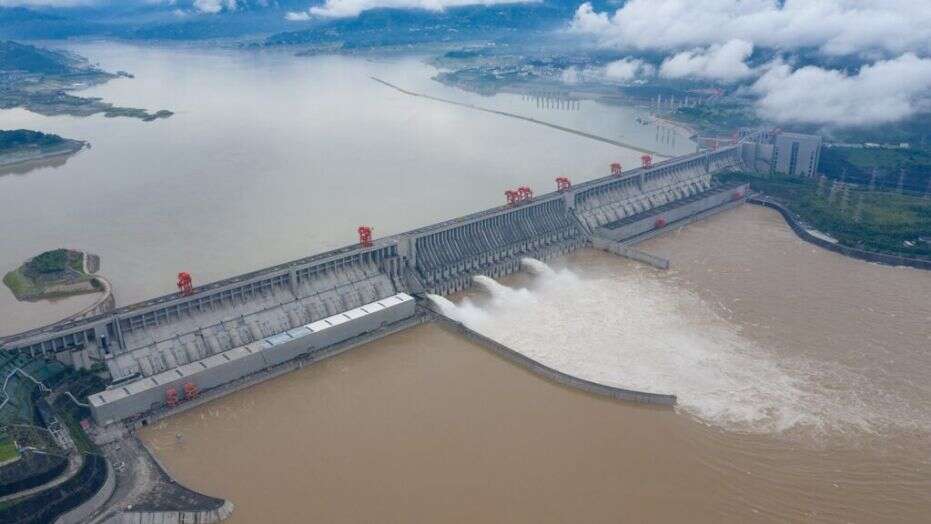
The Three Gorges Dam, the world’s largest hydroelectric station, Costfoto/Barcroft Media via Getty Images
The Australian philosopher Arran Gare, himself a communist, ironically sums up the failure of his own movement during his survey of the Soviet Union: “The environmental disasters of the Soviet Union illustrate the inevitable self-destructive tendencies and uncontrollable dynamics of any society that attempts to reduce people and nature to mere instruments of production. It shows that what is required to create an environmentally sustainable society is one in which the creativity of people and nature are fully acknowledged…and people are able to live as creative participants in a creative nature.”
To this I say, amen.
Conclusion: The True Indicator of Environmental Success
But surely, some might say, I am not being fair to the socialist countries mentioned above. The West has been able to reduce its emissions so much, these people may argue, because it has dumped its most dirty jobs to countries like China. It could also be argued, of course, that the Scandinavian nations have high emissions per capita because they have long and often brutally cold winters.
To this I say, certainly. Because societies are so complex, there are inevitably confounding factors in the capitalism-vs.-socialism debate. And that is the point. There is no magical solution to solving our environmental challenges. And neither economic framework is an automatic guarantee of environmental harm or flourishing.

There is no magical solution to solving our environmental challenges, it will take prudent decision making and hard work. Medium.com
For instance, the United States may indeed rely on China for a large degree of its manufacturing—but that has not stopped the US from having some of the cleanest industry standards in the world for the manufacturing that remains. And yes, the Scandinavian countries are cold, and it is perfectly within their rights to warm their homes—but the United States has more people than all those nations combined living in its northern plains, where temperatures are just as cold if not colder.
No, what truly drives environmental progress is prudent decision making, a robust incentive structure, and a culture of stewardship and dedication. Conservation has become a blossoming movement in the West, and those blossoms are beginning to bear fruit; while authoritarian nations like China, which in stark contrast have been permitting an average of two new coal plants per week, blatantly only care about their own advancement on the global stage.
What truly drives environmental progress is prudent decision making, a robust incentive structure, and a culture of stewardship and dedication.
I argue that only a capitalist nation can combine these three needs; only such a nation can fully incentivize and translate a people’s culture of stewardship into beneficial environmental results through a combination of market and prudent government incentives. And history has proven this to be exactly the case.
So next time an environmentalist advocates for socialism as a solution, be sure to set them straight using the one thing they don’t have on their side: facts.
By Evan Patrohay


Leave a comment