
The word stewardship is fast approaching the waste bin reserved for those overused and inflated words of the English lexicon. Modern sentiments have perverted its meaning and reduced it to impotence–the meager results of our efforts at natural stewardship its condemning evidence.
The word “steward” traces its etymology to the old English stigweard, “stig” for a portion of one’s property and “weard” for a guardian. The verb stewardship therefore contains two necessary aspects in its application: some property to guard, and someone that property is being guarded for.
In typical application within the environmental space, both requirements suffer from imprecision and ambiguity. When asked what we are supposed to be stewarding the response is often the quite oblique “nature” or “environment.” Nearly as helpful of an answer as telling a politician they must fix “the economy.”
But the question which would provide the answer to the latter requirement is often not even asked. Merely focused on the means, few in the environmental movement provide a satisfying answer for the ends.
And it is the answer to the second question, the for whom side of the stewardship equation, that is directly connected with the equally important question of why. Because if one is guarding the property of another, it is because that other has imposed some sort of an obligation upon him.
The Christian, of course, may reply confidently to each of these questions. We are commanded to steward God’s property, because his gift of human dominion over the earth, like any of His commands, contains within it a moral obligation. This obligation is the why; it is what puts the “steward” in stewardship. Because God did not give us power over the earth as its masters. He gave it to us as its stewards, to hold until “the creation itself [is] set free from its bondage to corruption and obtain[s] the freedom of the glory of the children of God” (Romans 8:21).
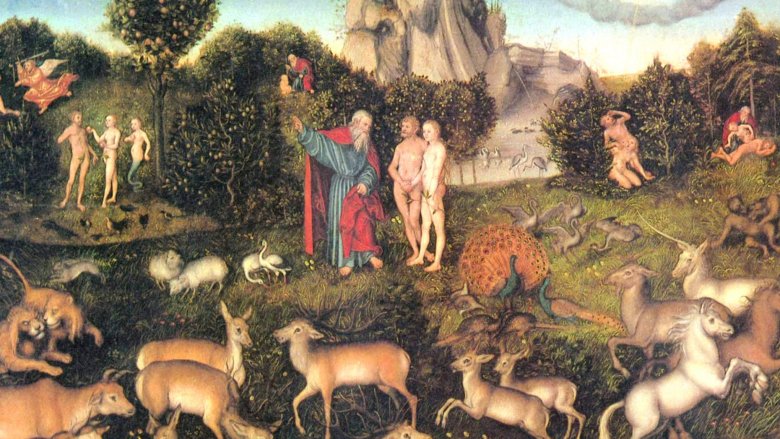
The Garden of Eden by Lucas Cranach the Elder
Yet, the cushy modern liberal mind has subtly altered this proper definition of stewardship into something far more self-centered, all while leaving its moral vestige behind (as it has for so many righteous words of old, most devastatingly “liberty” and “freedom”).
For in nearly every modern usage of the word we are stewarding nature for…who exactly? The royal we? The taxpaying public? Those are the usual answers. And for what cause? For recreation? For those “spiritual co-benefits” one hears so much about? All weak stuff.
And this, of course, is why those who babble on about “stewardship” in the modern sense make no real progress in the means, because they have lost sight of the end. By replacing the end of the act of stewardship from the known other (God) to the ambiguous collective (the body politic), both the moral and the practical sense of stewardship are mutilated.
Morally, the force for actually carrying out the caretaking is transferred from love, honor, and obedience to the same limpid egalitarian social bonds that have frayed everything in this nation from politics to road rage. This severs the essential connection between faith and works, which remains incohesive no matter how much lip service is paid to those equally ambiguous “co-benefits.”
And practically, turning stewardship into a democratic exercise at once means we must somehow impose the obligation of stewardship on ourselves (never what the word was intended for). So…does that make natural stewardship like, a New Year’s resolution kind of thing? Or maybe an “I swear I won’t goon anymore” kind of thing? I hear those have excellent track records.
As we have discovered these 250 years, it takes a lot more than a “body politic” to get something done. Human beings are motivated in their deepest core by the forces of love and obligation, not faceless corporations promising they’ll offset their emissions in the forest of some third-world country (not a scam–we promise!!). But by actually getting to work in our own backyards at the scale of life.
The uncomfortable truth is that a populace ill-fitted to rule itself (a poor civitas) is going to have a sorry time properly managing its home (a poor oikonomia).
By flooding the word “stewardship” with a democratic egalitarianism it was never intended for, the story of environmental stewardship in this country has become that of the tragedy of the commons writ large: where all are perfectly aware that the tragedy exists, but are unwilling to remove the yoke of liberal democracy that brings all things under common responsibility by definition.
By Evan Patrohay
 Thoughts of an Environmental Conservative
Leave a comment