
If you are like me, you were born in this nation to parents also born and raised here. Perhaps you can trace your ancestry through the storied past of Americans from centuries prior. Maybe you are a proud immigré or a son or daughter of one; someone who came to this place because they loved it and sought to pursue their dreams here. Or maybe you are reading this from a country outside the United States, and these same statements apply to you in your own nation.
If you are like me, then you also care about your country. You vote and petition, you volunteer and educate, you anxiously discuss the politics of our day and age with your loved ones, always wishing and praying for the best for your home. In short, you act like exactly what you are: a citizen.
But to those who are the products of our voting and petitioning, the ones who lead us, you are not thought of that way. No, the word that comes out of their mouths is far different. To the powers that be in all developed countries, but especially those hyper-focused on the market like our own, you are called a consumer.
And all of us should take serious offense to this.
The word drips with an air of reductionism, materialism, weakness, and dependence. For all that we love and do and care for this country, those who claim to have our best interests in mind more often than not consider us nothing more than numbers on a page.
Read just about any government report, listen to any politician’s speech, or watch any portion of the news and consumer is the word you will hear repeated over and over. Whether the American people are praising their leadership or against them, the argument is always reduced–often snobbily–to purely economic matters. Are the people angry? Oh that’s just the affordability crisis! Are the polls up for once? They’re just happy that gas is $2.00 a gallon, that’s all! Give them cheaper eggs and they’ll be quiet!
Do these things matter, and do they have a part to play in the public sentiment? Of course. But while the market gets its limelight, our education rates are dropping like a stone, our families and the very sexual relations that found them are shattering, and we have become barely able to function as neighbors let alone a people. And it all barely makes a ripple in comparison.

These economic fixations are a two-way street, however, and the public has its part to play. Nowadays, the American people often seem to think a “better economy” is the only thing our politicians should be expected to provide, as if society was built on the market alone. As polls consistently show, the economy takes precedent over all other matters, be they educational, familial, or social. All while the only “signs” of a better economy are increasingly toxic goods, more poisoned land, and declining health.
Behold America the idea! America, where we are all residents and proud individuals, loosely tied by our friendly local Costco!
I in no way mean to take lightly any person’s concerns over their job or wealth. I only point out our strange infatuation with all things economic. And I do mean strange. No matter where in our lexicon, all tends to reductio ad mercatus. We speak of everything using the language of markets: elections are the “marketplaces of democracy,” interpersonal relationships are the “dating market,” and even nature has a “political economy”!
As an unusually prescient Vox article summed it: “Americans think like shoppers, not like citizens”!
One very accurate prediction from Alexis de Tocqueville, a man famous for many of them, was that in an egalitarian society where all are equal before the law, wealth becomes the distinguishing factor. Enter our economic fetishes, which latch onto us like a demon.
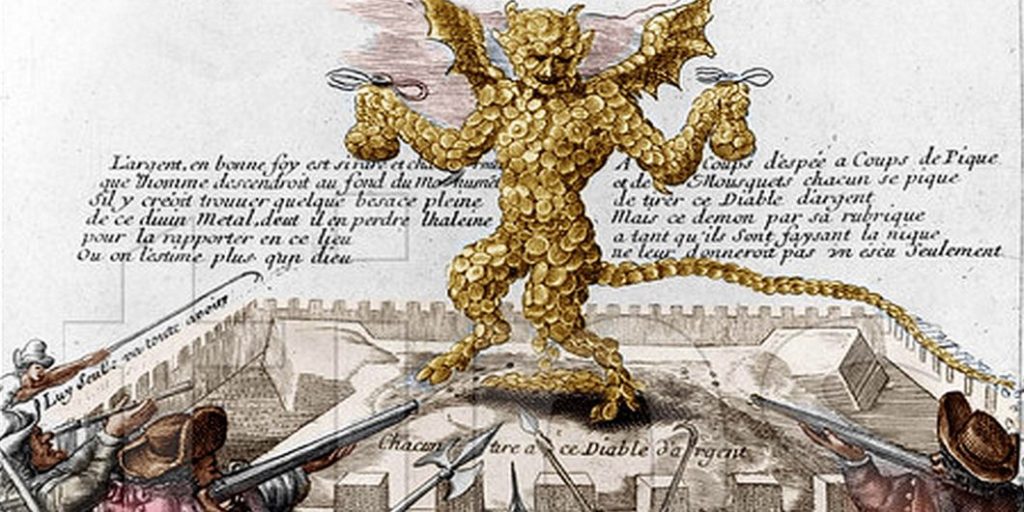
Jacques Chéreau, “Le Diable d’Argent” (1720)
I will leave you with one final point, which some of you may find offensive.
The reductionism of individuals to consumers in capitalistic nations is EXACTLY the same as the reductionism of individuals to class in socialistic nations.
And that is no coincidence.
Both systems seek to “liberate” the individual, whether for more choice or from allegedly oppressive conventions, but do nothing but make us slaves to something new.
By Evan Patrohay



Leave a comment