
The Paris Olympics are wrapping up, and I, like many Americans, have been reveling in its excitement. No other competition is more varied or more beloved, and none has more at stake. Like any two-week competition probably will, this Olympics has generated considerable controversy; the unacceptable inclusion of a threesome on camera (children watch this event!) and an insulting mockery of the Christian Last Supper during the opening ceremony, and a boxer with male chromosomes rising through women’s boxing are three such controversies. But instead of focusing on those controversies, I want to focus on something more optimistic and refreshing. Every four years, the Olympics reminds us of the importance of patriotism and love of home.

The Paris Olympics, Nicolas Briquet/SOPA Images/LightRocket/Getty Images
In recent years we have been awash in trendy calls for globalism and the ridiculous notion of “global citizenship,” which idealizes humanity as everywhere the same. These opinions often come from the top, from elites who talk of “new world orders” and attend globalization conferences such as the World Economic Forum in Davos, Switzerland.
Globalism as exemplified by the Davos conference is an interesting case of the strengths and weaknesses of the movement. As a primary goal, Davos seeks to develop and strengthen a more interconnected global economy, based on the theory that such international dependencies make conflict far less likely. History has proven this to be generally true, but with the trade-off of an incredibly complex and fragile global economic system that can be easily broken (as exemplified by the Covid-19 pandemic) and, of course, the reality that we now rely heavily on authoritarian and hostile regimes for much of what the global economy needs to survive (exemplified, for instance, in my previous articles on China and green technologies).

The march of globalism has also led to international structures such as the United Nations, a diplomatic body that again seeks to reduce the likelihood of conflict and provide a deliberative forum to navigate pressing international issues.
World Economic Forum/Ciaran McCrickard
The United Nations has a mixed track record of success, since when push comes to shove nations often place their sovereignty above that of the UN in judicial and other matters. It also includes with it the ironic reality that authoritative nations, because of their great number, are by default given a large seat at the table and the ability to influence international matters. The UN Security Council, for instance, which has the explicit charter of “maintaining international peace and security,” currently has Somalia, one of the most war-torn and violent countries in the world, as a member.
But there will always be trade-offs in international affairs, and despite the glaring imperfections in the UN and the global economy, more diplomacy is usually better than less. As such, most people would probably prefer that the UN exist than not. If the globalist movement stopped there, it would be far less controversial. But of course, it doesn’t. And globalism has directly led to two additional destructive movements: neoconservatism and international corporate capitalism.
Globalism Unhinged: Neoconservatism
Infatuated with power and idealism, many UN- and Davos-type elites envision a world where everywhere humanity is led by the same values, a naive ideology referred to as neoconservatism. Philosopher Samuel P. Huntington described these types of elites as ones with “little need for national loyalty…[who see] national borders as obstacles that are fortunately disappearing and national governments as residues of the past.” Neoconservatives, or “neocons,” are therefore the enemies of true conservatives, tradition, and love of home. They believe that, despite the existence of myriad cultures and traditions that prove otherwise, democracy generally (and the American flavor of democracy specifically) ought to be exported to all nations—and imposed forcibly if needed.
Is there anything wrong with increasing the scope of freedom and democracy in a greater number of nations? Of course not. The issue with neoconservatism is instead that it attempts to bulldoze through the delicate and long-standing traditions and cultures of a given place in an overwhelmingly interventionist way. This blundering approach is due to the haughty belief that America is an idea and not a place, as stated by Joe Biden and many other politicians. This highly reductionist talking point negates four hundred years of American and colonial history that have shaped our systems and values. Despite what Lindsey Graham may tell you, the average Middle Easterner did not grow up with English common law and Western constitutional thought.


Joe Biden and Lindsey Graham speaking, Andrew Harnik/AP; J. Scott Applewhite/AP
Of course, if you ignore this incredibly specific history and believe America is merely an idea, and if this ‘idea’ of America led to so much prosperity for the American people, then that idea can and should be imposed anywhere in the world. Neocon globalists see this as their duty. As such, every major American foreign policy conflict, intervention, and subsequent failure of recent decades has been directed by this misguided belief. The debacles in Iraq, Afghanistan, Libya, Ukraine, and countless other countries—which have each reduced American power in the world instead of strengthened it—have been neocon failures. Neoconservatives, who lecture the world on right and wrong and infamously attach policy strings to foreign aid, have hurt relations with many nations and pushed countries from Africa to Asia into the arms of China, who at least builds them infrastructure instead of lecturing them.
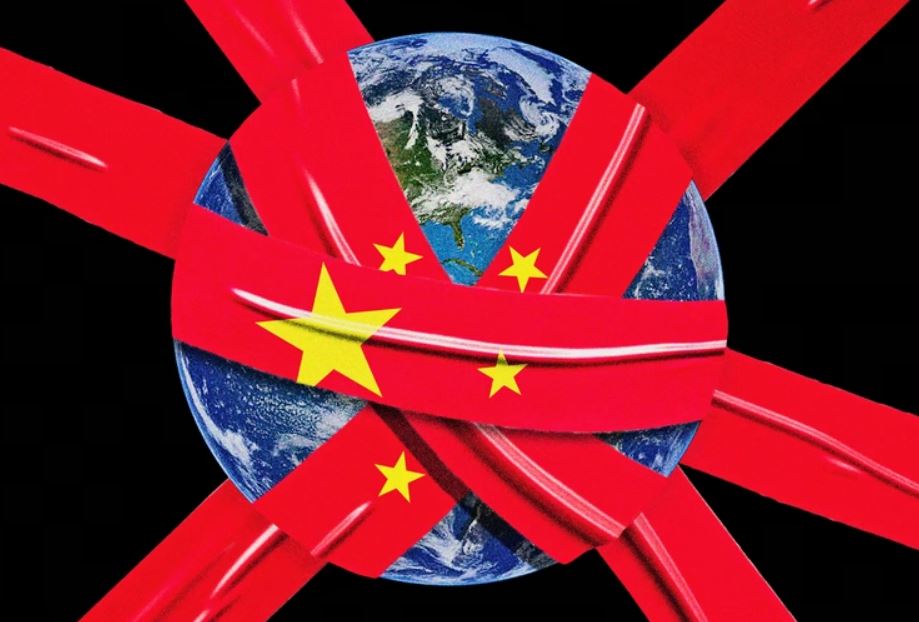
China’s Belt and Road Initiative dramatically visualized, Getty/The Atlantic
The interventionist actions of “enlightened” Western nations ignore Christ’s wisdom as depicted in Matthew 7:3-5, “How can you say to your brother, ‘Let me take the speck out of your eye,’ when all the time there is a plank in your own eye?”
Globalism Unhinged: International Corporate Capitalism
Secondly, infatuated with ruthless efficiency and cost-saving measures, international corporate capitalism—far removed from its noble birth as a Protestant ideal—has in the name of the “global economy” undercut the smaller economies and communities of their own nations and homes. The actions of these corporations, who have betrayed their home nations and become loyal only to profit, have made the common globalist justification of “lesser conflict” appear as a farce.
As companies grow larger, their loyalties to home grow weaker. The alleged list of corporations who rely heavily on cheap labor overseas is great, and an estimated one in four American manufacturing jobs alone have been sent overseas since 2000. The list of consequences of outsourcing is long, and includes reduced company loyalty and a chain reaction of outsourcing, once the outsourced countries themselves begin to look for an international edge. We must return to a love of people and profit—and capitalism can still do both. This is a far bigger subject that must be unpacked in future articles.
Remembering Home
Contrast the above sentiments with what Vice-Presidential candidate JD Vance has said on the campaign trail: “America is not just an idea. It is a group of people with a shared history and a common future. It is in short, a nation…People will not fight for abstractions, but they will fight for their homes.” As explained by another quote from Huntington, “People define themselves in terms of ancestry, religion, language, history, values, customs, and institutions. They identify with cultural groups: tribes, ethnic groups, religious communities, nations, and, at the broadest level, civilizations. People use politics not just to advance their interests but also to define their identity. We know who we are only when we know who we are not.”
America is not just an idea. It is a group of people with a shared history and a common future. – JD Vance
So many of our problems today, from economic issues to the difficulty in raising children, can be boiled down to the lack of community to raise us and the foolishness of a variety of globalist forces which overstep our natural friendly connections with each other. As intuitively exemplified by Edmund Burke, human relations exist in concentric and expanding circles, each with increasing distance and decreasing strength of affection—“the little platoons we belong to in society.” The first of these, family, is naturally the strongest, followed by community, state, and nation.
But globalism and neoconservatism seek to push our natural affections beyond their natural limits. Leo Tolstoy, for instance, in The Kingdom of God is Within You wrote that international communism was destined to fail because a generic, abstract “love of humanity” is not a strong enough bond to hold a society together. Nor could a Christian love directly do this, he argued, because its loyalty is first to God and above mankind. Globalism and neoconservatism are indeed guaranteed to fail because they are against our nature—and the innumerable casualties scattered within their wake are proof of this.
Differences between peoples and nations are a part of what adds flavor and interest to life, and this is why we should celebrate the Olympics all the more. At the Olympics, gone is arrogant lecturing, outshined by the purity of sport and international competition. (Though we haven’t quite shaken the corporate ads!) It is an excellent blending of the local, national, and international: each competitor has their own personal story and path to the competition. Each their own triumph over difficulty and pain. These identities and personal stories exist beside and within the national identity of their home countries—they are not absorbed or negated by this patriotism, but taken up by it, and it is precisely these local stories which amplify our love of country.

Gabby Thomas holding the American flag after winning 200-meter gold, Michael Steele/Getty Images
The thought that in our nation, a person of our own stock can possess the strength and skill necessary to compete and win against the best in the world is what makes the Olympics so special. And the fact that we see similar personal stories and triumphs combined with the same national pride from all other nations, adds to this electric air. Like no one else, Olympic athletes provide us the opportunity to cheer for them, their stories, and our home countries together.
Policies and philosophies that can combine and subsequently strengthen the local, national, and international exist elsewhere in our world—though difficult to find. Yet it is precisely the mixing and balancing of these three levels that gives these ideas their strength. Over time, we will explore these ideas here together.
By Evan Patrohay

 Thoughts of an Environmental Conservative
Leave a comment