
Let’s talk about the anatomy of a star.
In every star, two forces are constantly in tension. The first comes from deep inside its fiery interior: the violent, flaming force of atomic fusion. The second comes as a consequence of its great mass: the smashing, squeezing force of gravity. The first force seeks to push the star outward. The second, to pull inward. To keep the star stable, these two forces must balance. While they are, the star may persist for eons.
The force of fusion varies over the life of the star, burning hotter or cooler depending upon the elements being fused. But the force of gravity remains ever constant and indifferent to the furor happening within.
So long as fusion combines hydrogen into helium, the two lightest elements, the star burns cleanly. But when these fuel sources run out–when helium is combined into ever heavier materials–its blazing lifeblood dwindles. Eventually the core ossifies into immobile iron, which consumes more energy through fusion than it releases. When this critical event occurs, the tenuous balance of the star is overcome by its constant force; gravity collapses the star upon itself. When this occurs, the star emits more force in a moment than it did over its entire existence, and it is utterly blasted to pieces in an immense supernova.
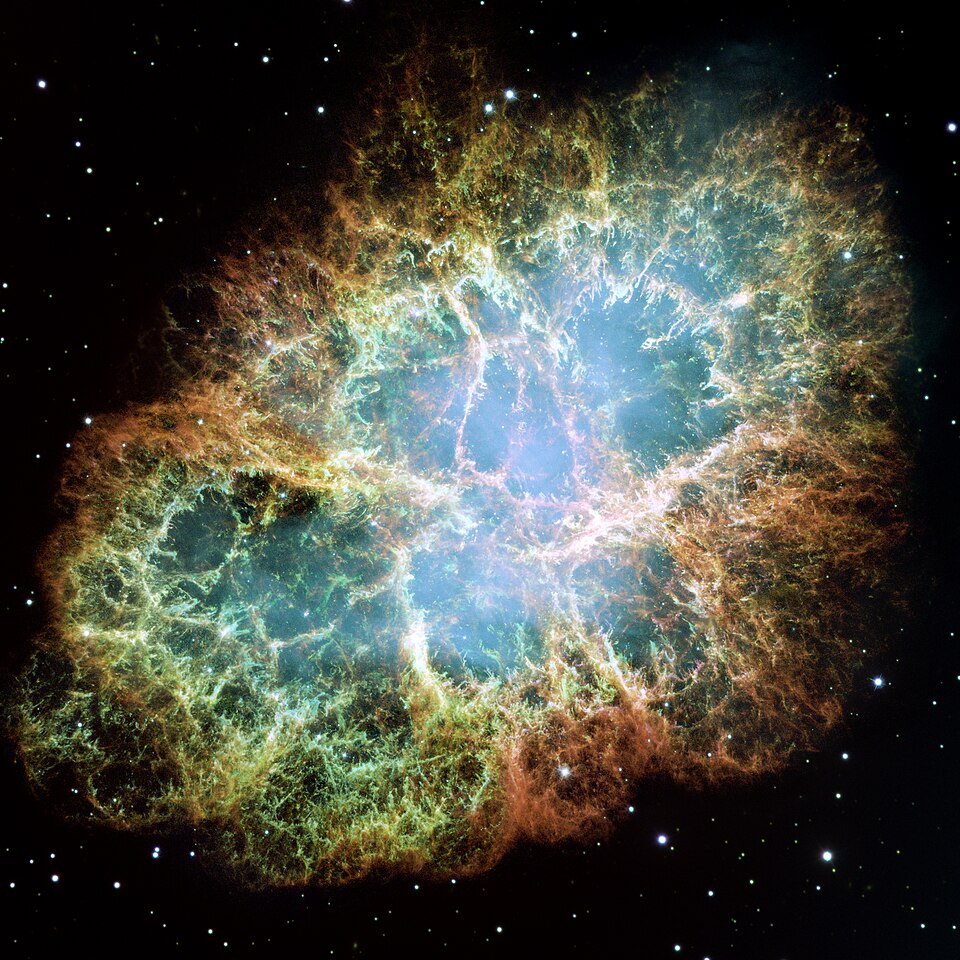
The Crab Nebula, the remnants of a massive supernova. Credit: NASA
—————————————————-
The tension of forces in a star, and the resulting supernova, represent an apt analogy for the tension between human free will and the unchanging normative forces of the world (what we may call natural law, or the will of God). The massive entropy that results when the two forces are put out of balance (the supernova) hints at the inevitable consequence if human will and natural law are not kept in harmony. This is true of both our ecological interactions (ecological law) and moral interactions (moral law).
Because human beings are sinners, it is impossible for their will to be fully in communion with God’s, hence the tension. But it is true that human will can be more or less in communion. Therefore, the closer human action follows the grain of ecology and morality, the more equal the two forces become. There are communities and peoples that have remained in harmony with the ecosystem they call home over eons, never giving nor taking more than is required.
But when human will crosses the line to rebellion, to “going against the grain” with nature, the opposite is true. In this case, though at first the human force appears stronger, it is undermined by its own arrogance. Like a rock to rushing water, under these conditions human capacity is with time worn down by the unchanging forces of nature to nothing. When an unstoppable force is faced, it will crush all that oppose it.
Aldo Leopold compared the communion and rebellion of man as “man the conqueror versus man the biotic citizen.”
He writes, “the conqueror role is eventually self-defeating. Why? Because it is implicit in such a role that the conqueror knows…just what and who is valuable, and what and who is worthless, in community life. It always turns out that he knows neither, and this is why his conquests eventually defeat themselves.”
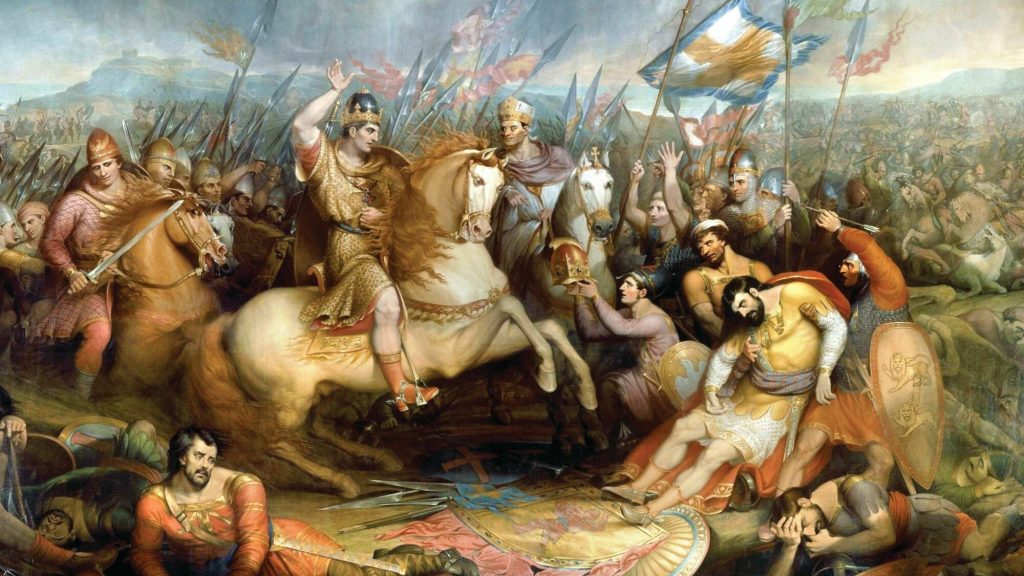
William the Conqueror at the Battle of Hastings. Credit: Frank Wilkin
Whether it is by pumping industrial inputs of fertilizer into land that erodes its natural regenerative capacity and therefore conditions it to an increasing dependence, or by unrelentingly taking above the naturally replenishing carrying capacity of a species, rebellion against creation always ends in chaos. We inevitably discover that we can’t “go it alone” and in fact depend upon the incomprehensibly complex and symbiotic balance of the natural world. The new term natural security (a term worthy of a future article) describes this dependency quite well.
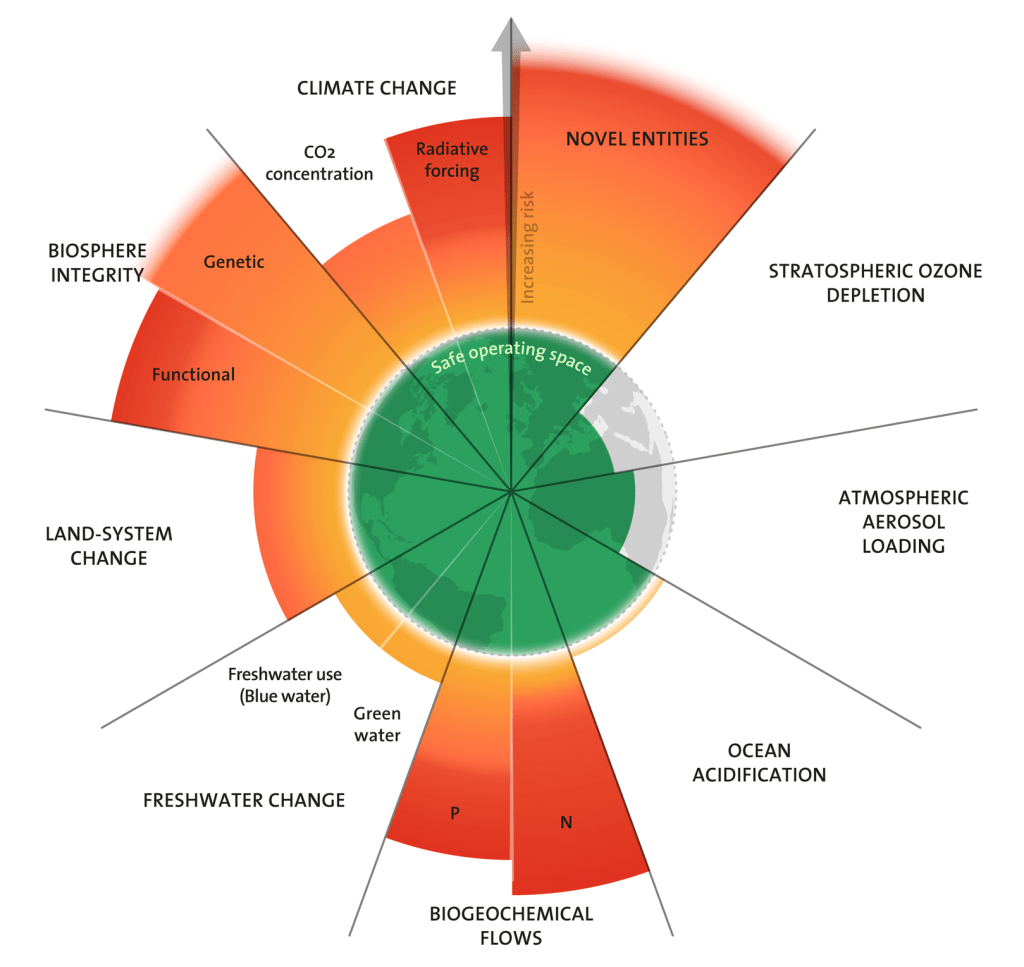
The Stockholm Resilience Center’s “Planetary Boundaries,” an apt, albeit secular tracking of the environmental supernova to come. Red shows where harmonious boundaries have been exceeded. Credit: Stockholm Resilience Center
When man’s conquest eventually fails, enter the “environmental supernova.” Drought, famine, acute economic loss, political unrest–entropy is dramatically increased in a myriad ways. I don’t want to sound as dramatic as the libs, and much of what they say is overblown, but it is undeniably true that any individual or society that seeks to overcome the limits solemnly imposed on them will find the freedom these pursuits promise pillars of salt and sand.
This is because the cardinal law of the conservative and the Christian is:
Obedience to natural law increases order. Rebellion increases entropy.
As a final note, I will stress that the promise of chaos and brokenness that follows rebellion applies as equally (if not more so) to the moral law as it does the ecological law. In fact, one finds that license is often amplified between the two in a positively reinforcing feedback. If we act as conquerors in one, we do in the other.
Modern man is taught by liberal ideologies that no limit exists for him on earth beyond the constraint of his own free choice. By this he rages against the moral forces imposed lovingly on him by God: sexual restraint, temperance of greed, devotion to the family, etc. The fruits of this rebellion have been passed down in a societal supernova of its own sort: the aspects of disease and addiction, oppressive globalist capitalism, and rampant divorce.
Ultimately, whether it is brokenness in our communities or decline in our environment, we find the key detriment is always man acting as a conqueror. Will we seek to work with creation’s patterns? Or will we continue to impose our desires on the world? One thing we know for certain: nature and morality always win.
I will leave you with what may be Aldo Leopold’s most famous words: “A thing is right when it tends to preserve the integrity, stability, and beauty of the biotic community. It is wrong when it tends otherwise.”
So remember the natural law, and pursue God’s will. Our wholeness depends on it.
By Evan Patrohay

 Thoughts of an Environmental Conservative
Leave a comment