
There is a surprisingly large cohort of self-professed environmentalists who believe that humanity’s greatest and most damaging impact to the natural world has been our release of carbon emissions. Whether it has been media mass psychosis or popular culture that has made them think this I do not know.
Oftentimes when I encounter this opinion, it is as if cancelling our carbon emissions were the silver bullet that would solve most of our environmental woes. Granted, these self-professed environmentalists do still say they care about the clearcutting and plastic pollution and invasive species and whatnot, but press them and carbon is always what they return to. It is their lingua franca, their common denominator–at times ad absurdum.
The line of thinking I refer to is well-captured in a passage I recently read from Ezra Klein and Derek Thompson’s Abundance. The main thesis of Abundance is that America must build again, and in order to construct this plenty, they need more efficient government processes, more agreed-upon outcomes, and–oh, more energy. A lot more energy.
Now “more energy” is not a common trope of liberals like Klein and Thompson, so they add a key qualifier. This is to be clean energy! Shazam! No moral headaches here. Solar, wind, nuclear; they are “all-of-the-above.” Any clean energy is on the table.
Now, how much more energy is going to be needed to power Klein and Thompson’s techno-powered abundant future exactly? They write the following: “One way to put [it] is for every fifteen years from 2020 to 2050, we need to build the entirety of our electricity grid worth of supply again.”
An entirely new grid every 15 years you say? Why that’s only a handful of a trillion kilowatt hours! That shouldn’t have too many unintended consequences. As long as you promise it’s clean!
Now what Klein and Thompson have introduced here is an interesting concept: that of unlimited sustainability. That it is possible to keep growing and growing the grid, but because it is “clean,” there not really be any detrimental impact. They may accuse me of simplifying their argument here, but their claim is made without batting an eye. From LA to Davos, claims like this are made as if greenhouse gas emissions were our only problem.
What this type of environmentalist doesn’t stop to tell you is that, of course, unlimited sustainability is an oxymoron. They miss the fact that the natural world is an unfathomably complex whole, of which carbon dioxide is only a small part. And of course they decline to inform you that they are part of a highly ironic subset of liberals who call for “sustainability” while simultaneously removing any idea of qualifying limits. Perspectives like these narrowly and myopically define sustainability solely in terms of carbon, as if greenhouse gas emissions were our sole and lasting debt to the natural world and the only way we have wounded it.
Was it carbon that cut down the Amazon? Was it carbon that exterminated the passenger pigeons? Was it carbon that caused the Mississippi Delta to suffocate? Was it carbon that carelessly wasted away over decades inches of rich, Midwestern soil laid down over eons?
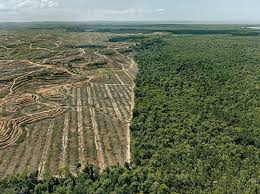
Yes, many of these things were powered by carbon. But that is exactly the point. Merely replace the carbon with another source of power and these things will continue unabated. Where our energy comes from does not matter as much as what we use it for. We are told to double our energy every 15 years, which is effectively to say we are to do everything we’re already doing, but more. Just changing our energy source, without changing our hearts–i.e., ridding ourselves of humanity’s current master-slave relation to the natural world–is to make no noticeable impact upon the health of the planet in our lifetime.
The sustainability buck does not stop with carbon emissions only. That would be to grossly underassess the true impact a misguided humanity has had on the globe. Habitat loss, overharvest, monoculture, invasive species, apathy. These are the predominant contributing factors to the heart-wrenching losses to wildlife and ecosystem function we witness across the globe.
It is telling that concerns about nature, beyond carbon of course, have literally no mention in Abundance. No doubt Klein and Thompson would argue that they really do care about all aspects of nature, but their actions, like the actions of so many, speak otherwise. Clearcutting swathes of forest, decimating their ecosystems (and introducing tons of invasive species, look it up) for a few megawatts of carbon-free solar energy is NOT a trade that any self-respecting “environmentalist” would make. It just isn’t.
Perhaps this is a major reason why so many conservatives have a difficult time buying into the modern environmental movement. They live next to a thousand-acre parcel freshly clearcut for another cookie-cutter neighborhood, read how their ancestors wiped out the buffaloes, and wonder why they can’t see lightning bugs in the woods like they did in their youth, while puffed-up “experts” tell them their carbon emissions are the real reason why the fish their community has been overharvesting are harder to catch. The average American can see through the nonsense: if they are paying attention–and not enough do–they quickly see that humanity’s carbon emissions are but a distantly indirect cause of our environmental woes.
I want clean energy, I want more energy, and I want to reduce emissions, but as far as the environment is concerned, there are far bigger issues at stake than just carbon. Our species won’t care if the planet stops warming if they don’t have a home and have only plastic water bottles to eat. It is time for carbon-obsessed liberals to acknowledge this. This, limits, and the holistic nature of things.
By Evan Patrohay
 Thoughts of an Environmental Conservative
Leave a comment