
“Keep your eyes on the stars, and your feet on the ground.”
– Theodore Roosevelt
“The heavens declare the glory of God, and the sky above proclaims his handiwork.”
Psalm 19:1
The psalmist writes in grandiose terms of how all creation trumpets God’s immaculate glory, most spectacularly from the dazzling night sky. Indeed, when every star is out, it is difficult to find a scene more sublime.
Humans talk much about glory these days too, and I admit there appears much to glory in. Our technological advancement has reached heights once relegated to the realm of science fiction. Whether it is AI that promises transformative superintelligence or medical advancements that declare obesity a scourge of the past, techno-optimists the world over promise such achievements represent a semblance of glories to come.
And yet, while “the heavens declare the glory of God,” I have been struck by how our glories–our technologies–consistently appear to obscure his. For in our most glorious cities, places filled to the brim with the state-of-the-art in human advancement, no one can see the stars. And even where the night remains dark, the sky is saturated with gleaming satellites that boast like stars but deceive the eye.
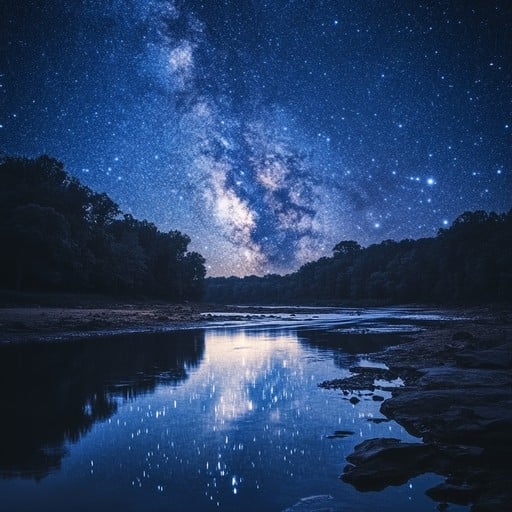
Modern technology has all but obscured the night sky for most of the world.
In American Technological Sublime, David Nye traces how over time the modern individual has shifted from admiring natural wonders to revering the man-made. The growing presence of the “technological sublime” in the American psyche, he writes, has come as technology increasingly crowds out the natural.
Like Nye suggests, at times it does appear that the “glories” of human creation are mutually exclusive from God’s. While God’s glory stems from his fullness of “grace and truth” (John 1:14), the chief advancements of modern man increasingly ring hollow and distract from the truth. They often crowd out our ability to appreciate creation, or even to see it at all.
Generative AI, for instance, is in the business of producing things indifferent to truth. Digital feeds are saturated with fake photos and videos, some of such high quality as to be genuinely deceiving. Our devices, which direct our eyes to artificial screens and content, do so by turning them away from what is natural and real: our families, neighbors, and the outside world.
Our cities, the most exemplary places of human technological prowess, are wrapped in artificial asphalt, glass, and concrete. Their consolatory, man-made parks serve as a mere pittance of the real thing. And though the annals of history ring piously with the zeal of scientists eager to use their craft to draw closer to God—its Newtons, Galileos, and Pascals—many of modernity’s most famous scientists—its Tysons, Hawkings, and Dawkins, have mocked any idea of the divine while boasting of humanity’s growing control over the intricate functions of nature.

Photo credit: George Hammerstein/Getty Images
For many such people, creation is not viewed as a gift to be stewarded but matter to be forcefully ordered to “enlarge the bounds of Human Empire,” as Francis Bacon once put it. Even with the best of intentions, such a conceited attitude blinds one to natural limits, weakens the desire to work alongside creation’s patterns, and strives to impose control upon the world.
We are still mortal, and our environmental troubles have increased as the “technological sublime” has progressively pulled our view away from the natural world. It is as the authors of The Liturgy of the Land note: when the artificial crowds out the natural in human life, the more mankind is left with the only thing it has ever created solely by itself: sin.
And so there exists a tension between God’s primary creation and humanity’s secondary creation. The greater our creations have become, the more hollow they have appeared in contrast to what was here before us. Yet Scripture is clear that God encourages human creativity: Adam was tasked with naming the animals, craftsmen were tasked with weaving the Tabernacle, and the faithful are told to “sing to him a new song.”
How then, can the glories of human secondary creation serve the greater glories of God’s primary creation?
———————————-
To begin, it is undoubtedly true that man possesses glory of a particular kind. Psalm 8:5 writes: “You made them a little lower than the angels and crowned them with glory and honor.” Yet, in this passage the status of human beings in the hierarchy of creation comes from nothing they do themselves. Instead, their glory is necessarily connected to God’s providence and provision. Human beings have glory because he crowned them.

Christ Enthroned by Elias Moskos (c. 1653)
In contrast, Psalm 96:7-8 describes the origin of God’s glory with the following: “Ascribe to the Lord, all you families of nations, ascribe to the Lord glory and strength. Ascribe to the Lord the glory due his name.” There, glory is ascribed to God, which means “to regard a quality as belonging to.” While his glory is due him, man is crowned with it, and crowning requires the action and forbearance of an outside, more powerful force that can place the crown on one’s head—one who stands while the other kneels.
Therefore, the tension between primary and secondary creation is unsurprising. Because we are not the universe’s primary mover, our creations carry with them an immutable artificial character that even at their best makes their glories a mere shadow of the real thing. In a substantial way, our creative acts are not far removed from the process behind “generative” AI, which disassembles and rearranges existing substance into a new realistic format. For we too have merely extracted, disassembled, and rearranged what was preexisting on this earth to build our structures, pave our roads, and fabricate our computer chips. And just like the use of AI, such generations are only useful insofar as they mimic what is truly real: the patterns of the created world, its beauty, and truth.
Once during college, a professor told my class a story that serves as an apt metaphor for this tension. Once upon a time, a scientist became adamantly determined to study his Christmas tree. He disassembled it and disassembled it, from its ornaments to its branches to its needles and its very cells. He became thoroughly acquainted with each individual part. But, when it was time to put it all back together, it had been so hopelessly dissected that he did not remember how all the pieces fit together—and he had forgotten what the tree looked like in the first place.
So it is with science and human creativity. Those needles and branches could with effort be formed into the shape of a wreath, but we are fooling ourselves if our wreath is any comparison to the tree we began with.
My professor’s metaphor also bears striking resemblance to the theologian Irenaeus’ critique of heretics in his Against Heresies, worth quoting at length:
“Their manner of acting is just as if one, when a beautiful image of a king has been constructed by some skillful artist out of precious jewels, should then take this likeness of the man all to pieces, should rearrange the gems, and so fit them together as to make them into the form of a dog or of a fox, and even that but poorly executed; and should then maintain and declare that this was the beautiful image of the king which the skillful artist constructed, pointing to the jewels which had been admirably fitted together by the first artist to form the image of the king…and by thus exhibiting the jewels, should deceive the ignorant who had no conception what a king’s form was like, and persuade them that that miserable likeness of the fox was, in fact, the beautiful image of the king.”
Humanity is equally heretical when it lauds its prowess alone and believes it has correctly formed the image of a “king” just because it rearranged the “jewels” of our natural resources in a new way. Human creation is secondary, a mere reflection of the real deal, and only truly useful so long as that reflection is made as clear as possible. In other words, human creation must be a “co-creation” if it is to be truly praiseworthy, keeping within natural limits and unmuddied by any desire to impose itself upon the world.
Technologies that attempt to force against the grain of natural rhythms nullify co-creation and neuter glory. Industrial agriculture, which pursues brute efficiency through application of unnatural rates of fertilizer and pesticides, is a germane example.

Credit: Carolina Country
By contrast, regenerative practices that return health to soil and do not treat it as an unlimited resource to be squandered, allow human creativity (what we here call husbandry) to thrive within the natural bounds of ecology. Note that the latter practice is more difficult—but the pursuit of what is truly glorious in a fallen world will always be difficult.
In the end, humility is the only thing indispensable to co-created glory. We must remember that our creations can never outshine God’s, that we are at creative liberty not license, and we attempt to escape immutable natural limits at our peril. And whenever temptations of the “technological sublime” arise, remember how those same “victories” obscured the stars you will never see.
By Evan Patrohay

 Thoughts of an Environmental Conservative
Leave a comment