
One of the most common objections I hear Protestants give when discussing the Roman Catholic Church is the presence of too many “human rituals” in the Mass and daily life of a Catholic. Making signs of the cross, kneeling before entering the pew, saying certain phrases at certain times, or praying the rosary–no Catholic practice that is absent in the typical Protestant church (which is most of them) is safe from this complaint.
Protestants may make this accusation in reference to Isaiah 29:13, “These people come near to me with their mouth and honor me with their lips, but their hearts are far from me. Their worship of me is based on merely human rules they have been taught.” To further back up their claim, a connection is often drawn between these Catholic practices and the hollow faith of the Pharisees in Jesus’ time; i.e., Matthew 23:23, “Woe to you, teachers of the law and Pharisees, you hypocrites! You give a tenth of your spices–mint, dill, and cumin. But you have neglected the more important matters of the law–justice, mercy and faithfulness.”
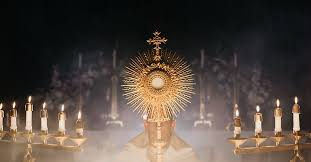
The Catholic practice of Adoration, by which a consecrated Eucharist is revered, is considered a fallacious “human” practice by most Protestants.
How ought a faithful Catholic respond?
My meditation on this question began when I visited two college friends at a Protestant mega-church last weekend. Their company was splendid and their fellowship wonderful, but in worship I noticed a stark contrast between what I witnessed then and what I have become used to in the Mass and other “ritualistic” traditional services such as can be found in some remnants of Anglicanism. It made me realize that the accusation of a church that possesses more of the “human” belongs rightfully on the shoulders of Protestant churches.
Firstly, it is important to understand that the order of worship in all churches is inevitably beset by a degree of human convention by nature. Whether a congregation is taught to kneel in a pew or make the sinner’s prayer at the front of the church, both of these actions are considered “human rituals” because they were intentionally fashioned by human minds for some purpose in how the church conducts its worship. The point at question, therefore, is not which church contains more of these “rituals” but which of them contain those that are more hollow and human-centric per Isaiah 29:13.
Remember that Christ’s issue with the Pharisees was not that they followed the law (“Do not think that I have come to abolish the law and the prophets” [Matthew 5:17]), but that they did so with hypocritical hearts. True worship, as the Scriptures say throughout, requires a sacrifice of a broken and contrite heart (Psalm 51:17).
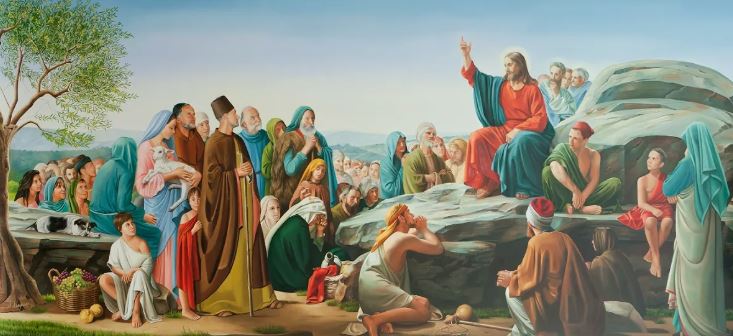
Sermon on the Mount, by Carl Heinrich Bloch, 1877
Let us approach the matter from the order of worship I witnessed in this mega-church. The service began, as most Protestant ones do, with a handful of songs led by the “praise band.” Unlike the Catholic Church and a dwindling number of traditional Protestant churches which sing psalms and hymns written over the centuries that reverently drip with doctrine and tradition, most Protestant churches sing–no, feel a pressure that they must sing–the newest pop “Christian” songs available on the market. These songs are almost all theologically hollow by comparison and would leave any visitor questioning what Christianity is actually about.
Obviously, some degree of human convention is unavoidable in the act of songwriting, but which of the two churches has the greater reliance on what is human: the church which sings (divinely inspired) psalms and reverent hymns that have been passed down over centuries, or the church that is constantly updating its music to stay relevant? The church that has put the prayers of some of the most saintly believers of the past to song, or the one that will no longer sing lyrics written more than 10 years ago? It is the church that is constantly fearing what the people will like that is oriented towards more of the “human.”
In fact, even the Protestant phrase “worship service” betrays the underlying human-centricity of Protestantism as a whole. Unlike the Mass, which is at all times directed towards the altar at the front of the church, Protestant worship is oriented to “filling” or “satisfying” the people in the pews. Protestant churches have removed this holy altar and replaced it–quite literally–with a human being on a pedestal or a band performing on a stage. What could be more human-centric than that?
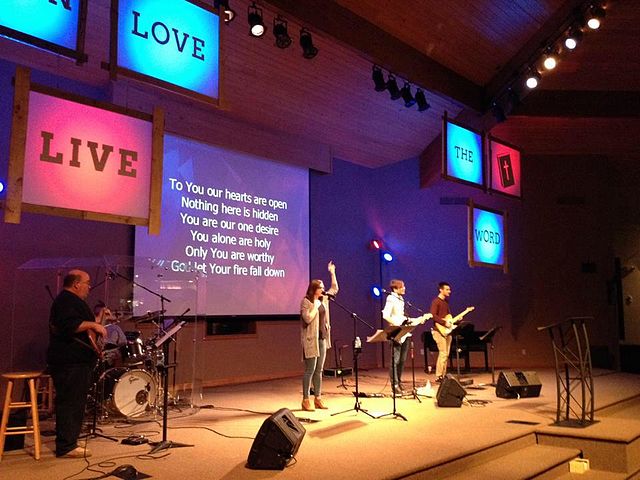
Protestant “rituals” such as praise bands are a far more human-centric practice than the form of worship conducted in the Catholic Church.
These stages and pedestals introduce opportunities for the worst and most prideful vices of human nature to infiltrate the act of worship. I was struck by how similarly the band and even the pastor appeared to actors. It was obvious that some of the singers were enjoying their time in the spotlight and were raising their arms, looking to heaven, saying quiet prayers between songs, and even jumping around to prove to the audience that they were passionate believers–or at the very least deserved to be up there. Some on stage were clearly uncomfortable by this, but still felt the pressure to do something charismatic and would half-heartedly raise their arms or move around. In his sermon, the pastor was clearly genuflecting his voice and mannerisms, like an actor, to make an impression on the crowd.
To be fair, some Protestant churches are worse about this than others. But this means of worship (and the inclusion of a 30-plus minute sermon every Sunday) that places the congregation’s attention squarely on one or more individuals at the very least introduces the tendency to create subliminal or explicit cults of following–something Paul was adamant not be done in the church: “One of you says, ‘I follow Paul’; another, ‘I follow Apollos’; another, ‘I follow Cephas’; still another, ‘I follow Christ’” (1 Cor. 1:12). As an aside, Paul’s warning against merely saying “I follow Christ” and nothing more should give nondenominational Christians (who do not typically examine the doctrines of Christianity deeper than a superficial “just follow Jesus”) pause. For the average believer cannot define what “I follow Christ” truly means in practice.

Catholics worshipping at the altar during Mass
Lastly, Protestants often talk about what they got out of the sermon when the service has concluded; a critical mistake. For worship is meant to be given as our offering to God, not the other way around. Any reciprocal blessings (and there are indeed many) are secondary consequences of this initial, humble offering of divine praise. (The official Latin term for this form of worship, which is due to God alone, is latreia.)
Even protestants who claim to know better still slip into using this human-centric language unknowingly. They speak of their process of “finding a church,” how they are waiting until they “feel a connection” or “feel called.” Sentiments made worse, of course, by the highly self-centered liberal spirit of this age. Before the sermon last Sunday, the lead pastor himself fell into this subconscious human-centricity when he wished that the congregation would “enjoy” the guest pastor’s preaching. So who, I ask, is supposed to be getting the most out of the worship: God, or the congregants?
And this is what is so frightening. Through an incredible sleight of hand, the spirit of this age has transformed even the holiest time of the holiest day into one where we are constantly assessing our thoughts and our feelings instead of losing ourselves in the worship of a higher being. It has turned our sights completely inward and to the earth, all while we believe we are still worshipping God in a properly outward fashion. Let us not forget that the very premise of Protestantism is that the individual ought to be allowed to interpret what the Scriptures mean for themselves. Protestantism as a whole has forgotten the key wisdom of Christ: whoever will lose their life will find it.
And so my judgement rests. Catholic “rituals,” which are humbly made and directed outwards and upwards, are far less human-centric than the “rituals” found in every sect of Protestantism, because Protestantism is fatally flawed by worship that–no matter how genuine–is corrupted by too great a presence of the self.
By Evan Patrohay


 Thoughts of an Environmental Conservative
Leave a comment