
“Any man and any power which would contest the irresistible force of equality will be overturned and destroyed by it.” ~ Alexis de Tocqueville, Democracy in America
Last, we spoke about the convergent evolution of the Protestant Church. There, the forces of democratic equality have caused conformity in a church that believes it is up to the individual to discern what is truth. We concluded that faith cannot survive on sentiment alone. Today we will discuss how the ramifications of democratic equality have reverberated throughout our nation.
– – –
All of America is beginning to look the same. Many of us were likely raised in a neighborhood filled with cookie-cutter houses, all lined in perfect unvegetated rows behind an entrance sign displaying any number of forgetful names. As young adults most of us will move to one of thousands of nearly identical apartment high rises, not caring where in the nation we might reside so long as the same familiar corporate restaurant and entertainment brands that mark “civilization” lie nearby. The thoroughfares we use to get there each appear truly non-distinct; every one a straight multi-laned road filled with too many traffic lights, lined with concrete and emblazoned with dozens of gaudy fast food signs, purposefully designed to not harmonize with the landscape so as to advertise the more effectively.



Should we move to a large city (because are you really somebody these days if you don’t?), it is likely one filled with a cluster of soulless glass-and-metal skyscrapers, their only modicum of personality the number of degrees off center they were designed to lean. Should we turn on the television after our day in one of many equally bland, modernist, and fluorescent-lit offices, we will see numerous politicians who each appear to be saying the same thing. In fact, the rare individual who happens to act as one and hold his own opinion, we notice, is usually the one most hated.
Alexis de Tocqueville, the early nineteenth century Frenchman who visited the fledgeling and newly democratic United States, once contrasted the two nations’ democratic and aristocratic societies in this way: a French citizen who published a controversial essay would regret it once berated by his countrymen, he wrote. An American, out of fear of the same, would never even publish it. Such, Tocqueville saw, was the overwhelming power of mass opinion. And in an era where “cancel culture” is an everyday phrase, his sentiments proved prophetic.
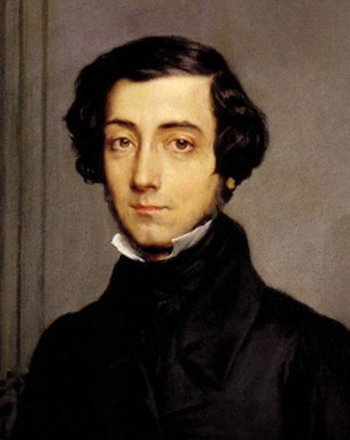
Frenchman Alexis de Tocqueville toured the United States over 1831-1832 and studied what motivated the young nation and its citizens.
The United States of America, a proud nation of individuals, has become a collective. A democracy, governed by the sacred voice of every person, now commanded by mass opinion. Somehow, in the republic whose foremost contribution to modern political thought was the sanctity of the individual, unique individuals are a dying race. How could this be?
Tocqueville identified the seed of this tragic irony as democratic equality. The social mobility that this equality affords, where any and all possibilities lie before each and every man, untethers them from any restraints and places the unshakeable idea of progress in their minds. Democratic nations, Tocqueville states, will be places of “continuous shifts…[like] a restless and disturbed spirit.” There is a reason why the United States has since its founding been one of the most innovative and passionate nations on earth–it is a product of its very democratic character.
This tragic restlessness, though materially productive, breaks down “the bond which unites generations to each other…each person easily loses the trail of ideas coming from his forbears or hardly bothers himself about it.” Hence, Americans today are an immensely deracinated people, on average moving nearly a dozen times in their lifetime. Always seeking the next opportunity, it is no wonder why we are filled with characterless cookie cutter houses; we never stay in one place long enough to turn them into homes.
When the place we live becomes a municipal competition for residents, when the housing market becomes a market that competes for us, then a place which looks, feels, and functions the same as any other has an equivalent chance for new movers. An equal people that lives in all places equally will make every place equal. Meanwhile, the rural places left behind by those in search of “progress” have become equally neglected and betrayed.
An equal people that lives in all places equally will make every place equal.
Another inherent aspect of this equality, Tocqueville writes, is that “each American has but recourse to the individual effort of his own reason.” Each, to use our phrase from before, is a “judge in his own case.” In aristocratic societies, where there are a few eminent and learned men, the many will look to the few for wisdom. But in an equal society, where none is positioned above another, “the predisposition to believe in mass opinion increases and becomes progressively the opinion which commands the world.”
Because every individual struggles to find the truth within themselves, the creeping suspicion becomes that truth will reside with the greatest number. Therefore, Tocqueville writes, the “very equality which makes him independent of each of his fellow men delivers him alone and defenseless into the hands of the majority.” No longer are beliefs shared by persuasion, he adds, but by the “immense pressure of corporate thinking upon the intelligence of each single man.”

Tocqueville realized that democratic equality will naturally lead to rule by the masses–a force he called “irresistible.”
When the United States resurrected the ancient idea of democratic rule, the Founders knew the dangers of its conformist tendencies. In Federalist No. 10, James Madison believed that only the maintenance of high diversity could prevent a collapse into tyranny, where “a greater variety of parties and interests” could prevent any one from becoming the majority and oppressing all the rest. In fact, Madison believed that a larger republic would be better at avoiding conformity, since it would mean all the more factions at its start.
Whether the Federalists were pulling a fast one, or whether they truly believed what they wrote, all clearly understand that their prediction proved false. Today, instead of being balanced by a great variety of parties and interests we are governed by two behemoths of groupthink, bounded by an ever-shrinking no-man’s-land of unique opinion. And conformity to one or the other has in recent years quickly, frighteningly, begun to incur legal implications. Consider the Biden admin’s arrests of Christians praying in front of abortion clinics, or the Trump admin’s persecution of Biden officials who themselves persecuted others for not embracing their particular Marxist conception of race and gender while their side was in power. See a pattern?

The United States is ruled by two monolithic parties, which suppresses individual opinions that do not toe party lines. Oftentimes, the distinctions between these parties appear blurred, leading to the common accusation of a “uniparty.”
Tocqueville, ever prescient, saw this reality on the horizon in the 1830s. “It would be impossible to imagine men forever unequal in one respect, yet equal in others; they must, in the end, come to be equal in all…They have a burning, insatiable, constant, and invincible passion for equality; they want equality in freedom and, if they cannot have it, they want it in slavery.”
Can such a future be avoided? One party is certainly unafraid of advocating for equality of outcome in all things, nor of dragging “the strong down to their own level” of mediocrity, a sinister ambition it innocently calls “equity”…and something Tocqueville also predicted. Ironically, in a search for unique individuality in a sea of bland Netflix-and-TikTok congruity, these same people drive a further stake into the heart of our nation by emphasizing differences too excessively. (Does anyone truly wish for a return to DEI?)
The reverberations of democratic equality do not stop at our nation’s sovereign borders but echo to the greatest heights and breadths of the world. Next time we will explore the convergent evolution of the world. And then, the cure.
By Evan Patrohay

 Thoughts of an Environmental Conservative
Leave a comment