
I have been on a journey as of late; a journey for the Truth. Since the beginning of this year, particular circumstances have manifested a “crisis of faith” in my life. But this is (praise God) not a crisis of belief in God or our Savior. It is rather a crisis brought about from the realization that the Protestant denomination(s) I had grown up in may not be as doctrinally sound as I was originally led to believe.
My search for the one true Church (a point where many Protestants would already petition a grievance), or at least the most correct church, has led me on a quest through the tomes of many theologians, apologists, and reformers across the ages–and to the pews of the various Christian denominations, sects, and splinters throughout the Charleston area. These churches are scattered like broken fragments of glass and stone, strewn like the rubble of the once unified Body of the Church.
It is far more enjoyable to remain blissfully ignorant of what those who shepherd me proclaim to believe–but our God demands orthodoxy: “Therefore, brothers, stand firm and hold to the traditions that you were taught by us, whether by word of mouth or by letter” (2 Thessalonians 2:15).
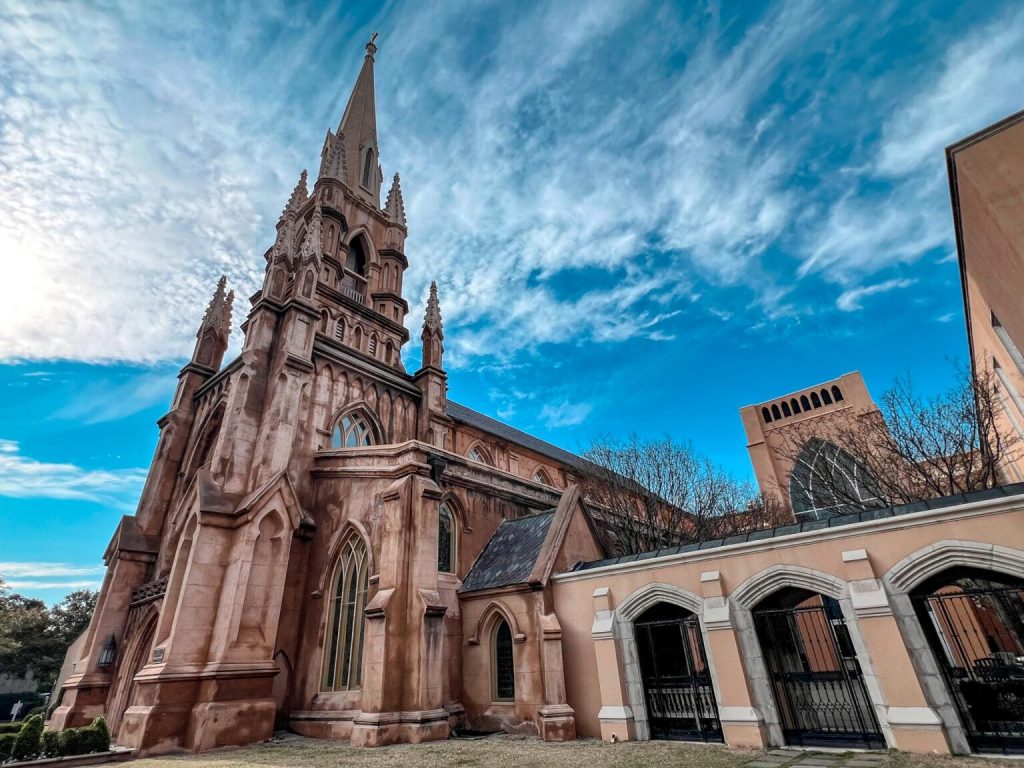
One surprising conclusion has materialized from this journey. With only occasional exception, each of the denominations I have explored appear, in practice, the same. Almost every one has succumbed to services pervaded by a conspicuous absence of liturgy, theologically vacuous and repetitive songs led by rock bands and charismatic singers, and a lack of decorum, where shorts and flip-flops are about as common as not.
While half of Protestant Christendom has fallen irreversibly into wokeness–as noted by many elsewhere–the half that has remained faithful has nearly completely fallen into what can only be described as lax, “laissez-faire” worship. Even supposed “high church” denominations like the Anglican Church in North America (ACNA) have “contemporary” services that function indistinguishably from something non-denominational. At the church I have been attending as of late, even the “traditional” services are split into one that is more traditional, i.e. led by the Book of Common Prayer (BCP), and one less traditional, with no BCP, sparse liturgy, and a guitar-led service.
Even healthy Protestant denominations like the Presbyterian Church in America (PCA) or the Associate Reformed Presbyterian Church (ARP), which by comparison still retain well-informed and well-read members who understand, love, and adhere to their doctrine, each lose nearly a dozen churches from their denominations every year like a leaky, dwindling bucket.
Why has this happened to the Protestant Church? I believe an ecological theory known as “convergent evolution” is a helpful analogy that can shed light on the answer. Applying this theory to present trends across the church, society, and global civilization reveals in clear terms the oft unspoken danger of democratic institutions, where an individual is allowed to become a judge in his own case. Today we will start with the church.
Convergent Evolution Explained
Though I use the language of convergent evolution, I in no way seek to discuss here whether the theory of evolution is true. I am merely using it as a useful and revealing ecological metaphor.
Convergent evolution describes the observed phenomena whereby distantly related species develop similar physical characteristics when living under the same environmental circumstances. According to this theory, the traits of two species placed under similar circumstances can be expected to “converge” over time, as certain traits will naturally function better under certain conditions than others. This theory explains, for instance, why both birds and bats have wings, and fish and whales have fins. Because a fin is the most efficient appendage for moving water, fin-like traits will be selected over time.
In this way, the environment is said to “act upon” the species, driving their adaptation in the same convergent direction.

Convergent evolution seeks to explain why distantly related species native to the same environments possess similar characteristics. Source: Natural History Museum
Convergent Evolution of Christendom
Now, let us apply this analogy to the matter at hand. In recent decades a similar functional convergence has been apparent in the Protestant church.
The denominations of the Protestant church exist analogously to different ecclesial “species.” Each species of church possesses a distinct doctrine, this analogous to its genetic makeup. Some denominations are more closely related than others, while others are more distant. Today, each sect has found itself placed within the same environment: modern Western culture.
The defining characteristic of Western culture is its democratic form of government. In the West, the masses rule. And in a democracy where the masses rule, a church liberated from any sort of ecclesial hierarchy (which would otherwise fix it in place) will naturally tend towards a style of worship that favors the masses: simple, entertaining, and charismatic worship. What I collectively call the “non-denominational bent.”
And so, over time, the cultural environment has “acted upon” these Protestant churches in tandem, causing them to convergently adapt. Gone are the solemn, reverent, and liturgical assemblies of our forefathers–many who became martyrs defending the very doctrines their progeny now disregard. For many, the steady march towards vacuous worship has come “not with a bang, but with a whimper.” Almost overnight, it has become omnipresent.
In a democracy where the masses rule, a church…will naturally tend towards a style of worship that favors the masses.
Take, for instance, the appearance everywhere of the “contemporary service.” The very existence of a “contemporary” service in a church is in itself ironic and divisive. Ironic because, ought the worship of an unchanging God meticulously set down by Christ and the Apostles materially change with time? Divisive because, such an idea at once pits the older segment of the congregation against the younger–the latter to which a “contemporary” service is clearly meant to placate. Any particularly stuffy youthful members who may prefer the way worship in their church has always been conducted will immediately feel a pressure to conform and follow the rest of their friends into the contemporary service, or risk isolation during one of the only times each week they can see such Christian friends while sojourning in a largely godless generation.
Two aspects of Protestantism combine to cause this phenomena of convergence. The first is Protestant doctrine itself. The more or less central opinion of most Protestants (especially in the low church) that simple “belief” in Christ is all that one must do to be saved has caused the church to stray farther and farther from the more complex doctrines of its founders. Protestantism’s discordant beginnings in the 16th century has also given its churches a generally reactionary tendency to avoid any sort of “ritual” that appears “too Catholic,” further simplifying their style of worship.
The second aspect of Protestantism that has caused its collective convergence towards the “non-denom” is likewise something implicit in its very founding. Something that, like Pandora’s box, was irrevocably unleashed by Martin Luther when he nailed his 95 Theses to the Wittenberg Cathedral. Individual discernment in the church. What I call “being a judge in one’s own case.”
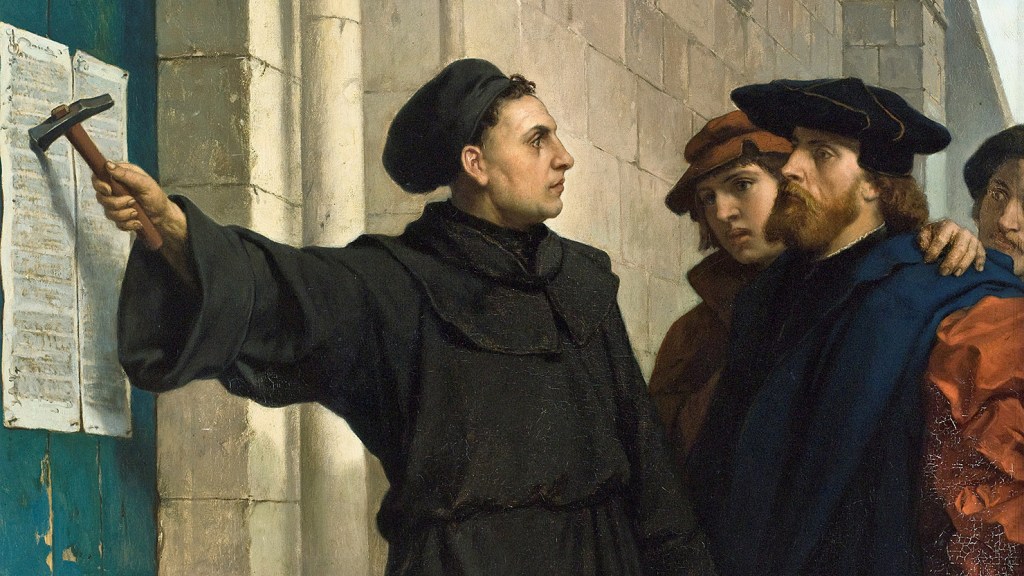
Luther Hammers his 95 Thesis to the Door – by Ferdinand Pauwels
The characteristically democratic impulse that each individual ought to be a judge in one’s own case has ripped away the old unity of Christendom and transformed it into a competitive market for souls. The individualistic principles of the modern West have, just as in its capitalistic economies, transformed what was once a solemn and amiable place to worship God into a competition that returns each Sunday morning. And just as in the market, the denomination that can best provide and adapt to what the people want will gain the largest market share.
The competitive advantage that a nimble and adaptable church possesses in this market is so strong that it is exactly why so many churches today label themselves “non-denominational.” Adherence to a denomination–where a church must heed a litany of smelly, outdated rules and dogmas–is a burden in such a fast-paced marketplace. Like fast food restaurants on a highway that each provide the same malnutritious meal because they know it levels the competitive playing field, so all our churches have become the same–each providing the same bland, malnutritious style of worship–because it means the average churchgoer is just as likely to attend one church as any.
Luther’s unleashing of individual scrutiny on the church in the 16th century has led the historian Eric Metaxas to phrase his action as “the revolution that would lead to all the others.” Metaxas put it this way:
“What Luther did was not merely to open a door in which people were free to rebel against their leaders but to open a door in which people were obliged by God to take responsibility for themselves.”
The characteristically democratic impulse that each individual ought to be a judge in one’s own case has ripped away the old unity of Christendom and transformed it into a competitive market for souls.
Then, and ever since, it has been up to every individual to discern the Christian truth for himself. The individual alone decides what he wants to believe based on the words of Scripture, and no degree of magisterium or hierarchy will move him otherwise. All claim to reach their conclusions through the Holy Spirit, but would the Spirit really help propagate the disunity of Christ?
The revolution that Luther began was the first dramatic overture of the modern philosophy of liberalism, more than a century before it became a coherent ideology. Liberalism likewise upholds the “liberty” of the individual to do as he pleases and has today become the societal instinct of every Westerner. Like two waves in harmonic frequency, liberalism and Protestantism have over the centuries mutually intensified each other, together producing the modern convergent church.
But the homogenizing forces of liberalism have not been isolated to the church alone, far from it. We will have much more to discuss on this subject in the future when we explore the convergent evolution of both American society and the world.
In closing this portion of our discussion I want to draw a contrast between liberalism and its counterpart conservatism. According to Pew Research, 74% of conservatives identify as Christians. The majority of these adhere to Protestant denominations.

Source: Pew Research
I believe every conservative Protestant Christian should seriously ask: what, exactly, is the Protestant church conserving anymore? Its splintering in ages past and its homogenization in our current time both proves that the answer is not much. As Raleigh Adams has wisely written, “A community in which faith bends to culture will eventually lose both its identity and moral authority.”
I will leave with two more wise quotes from Raleigh Adams on the nature of truth and liberalism in the modern church:
“Christianity is not supposed to be comfortable. It is disruptive. It forces confrontation with truth…Faith cannot survive on sentiment alone. It must be rooted in something real, something beyond personal preference.”
“Truth does not beg for acceptance. It stands on its own, often in defiance of the age.”
The Protestant Church, I argue, has approached the question of truth backwards. Truth is not defined by our sentiments but through the wise interpretation of those who came before us; those who ate and drank with Christ Himself. In believing the opposite, the Protestant Church has succumbed to this age. It is time for it to stand defiant, with truth, and cast off its simplistic and populist ways.
By Evan Patrohay

 Thoughts of an Environmental Conservative
Leave a comment