
*The opinions expressed in this article are those of the author alone and not necessarily those of the American Conservation Coalition Action or any other referenced organization.*
For the first time in living memory, what America’s leaders desire to do and what ought to be done for the good of our country’s economy, well-being, and natural resources are aligning. The next few years represent an unprecedented opportunity for progress in America’s sustainable development. And what’s more–each of these solutions originate from the conservative camp.
On the White House website, the Trump Administration has outlined several of its major goals, and a conspicuous “America First” message is present within every one. Because America is one of the cleanest developed countries in the world, this America First framework holds the key to both our environmental and economic well-being. When America looks out for its best interest, when it brings manufacturing and energy production to its home soil, cleaner development inherently follows; above and beyond what would be had from outsourcing our needs to dirtier foreign manufacturing chains and without the need for the stymying, suffocating burdens of a Green New Deal.

The header to President Trump’s priorities on the White House website. Front and center is the desire for American energy dominance. whitehouse.gov
Near the top of the administration’s list is a goal which provides the nexus of this opportunity: “Make America affordable and energy dominant again.” Four key underlying objectives include streamlining permitting, energy independence and dominance, building new infrastructure, and an America First trade policy. Unlike what many may tell you, each of these goals flow hand-in-hand with what is needed to make the United States a cleaner, more sustainable country. Like a four-legged stool, each of these objectives within President Trump’s vision support one another and are not possible when apart from the rest.
These four objectives are also precisely what several conservative environmental groups have long advocated for, presenting a first-of-a-kind opportunity for party unity to achieve American prowess and environmental goals. Examining the platform of one of these organizations, the American Conservation Coalition Action (ACC Action), reveals the deep harmonization between the Trump Administration and the environmental right, and why their solutions truly work.
American Conservation Coalition Action
In February, I had the pleasure of joining ACC Action on Capitol Hill to discuss conservative environmental solutions with several of our nation’s elected representatives. ACC Action was founded in 2018 by a group of young conservatives determined to fill ideological gaps in the environmental movement and champion market-driven, common sense environmental solutions.

The ACC Action logo. Credit: accaction.eco
Before we entered those hallowed halls, we sat with multiple experts to discuss why such solutions are so desperately needed to bring common sense, optimism, and practicality to our environmental debates. The organization’s platform during the event was as follows: 1) Let America Build, 2) Unleash American Energy Dominance, and 3) Unleash Nuclear Energy.
Population growth and new energy-intensive technologies like artificial intelligence are pushing America’s grid to the limit. On his first day in office, President Trump declared an Energy Emergency, writing: “An affordable and reliable domestic supply of energy is a fundamental requirement for the national and economic security of any nation.” All three of ACC Action’s platform points are necessary to solve this energy emergency.
– Let America Build (Permitting Reform) –
Firstly, permitting reform is critical to construct new energy infrastructure that is necessary to continue meeting demand. New power plants, transmission lines, and other infrastructure will not effectively solve the time-sensitive energy challenge if they take more than a decade to permit, let alone build. As wryly admitted by one panelist during the discussion, it took America eight years to move from JFK’s vision of going to the moon to making it a reality while today one can’t even build a transmission line in that amount of time. The rapid implementation of AI, streaming, and other energy-intensive technologies to our grid far outpace this embarrassingly sluggish clip.
Because America is one of the cleanest developed countries in the world, this America First framework holds the key to both our environmental and economic well-being.
When the permitting process is improperly long, timelines of investment, return, and even presidential and political cycles are mismatched. This causes the danger of “changing the game mid-flight” as new officeholders change regulations in the middle of the process. Furthermore, regulations like the National Environmental Policy Act (NEPA) and the Endangered Species Act (ESA), for all their good, have become weaponized to mire infrastructure projects in unnecessary litigation.
Consider Congressman Bruce Westerman’s (R-AR) new ESA Amendments Act of 2025, that would limit aimless litigation by placing a cap on attorney fees, require fee transparency, and defer lawsuits related to reversing species delisting for five years. Allowing only a temporary period for lawsuits, instead of multiple suits at every permitting stage like the current system, would also help. Allowing state and federal permitting processes to occur simultaneously would be beneficial too, as would grandfathering projects into new procedural changes if they occur after the permitting process began.

Congressman Bruce Westerman (R-AR), chairman of the House Natural Resources Committee. Credit: Greg Nash
Not only is infrastructure needed, but minerals too, which should be domestically sourced to reduce reliance on hostile Chinese sources and market volatility. Unfortunately, it takes an average of 29 years to permit a mining operation in the United States, the second longest in the world. This dramatically hinders President Trump’s infrastructure and energy goals.
– American Energy Dominance (Energy Incentives) –
Producing energy–especially new sources of energy–is also capital intensive. President Trump’s goal of energy dominance and energy affordability all require proper incentivization to be feasible. This is especially true given the estimated need for hundreds more gigawatts of power to meet surging American energy demand.
One key means of incentivization is through retainment of clean energy tax incentives provided in the Inflation Reduction Act (IRA). These incentives, such as “48E,” which provides a 30% tax credit to support investment in carbon-neutral energy facilities, prove that there are bright spots within the IRA and it should not be repealed wholesale. Leading energy executives and Republican congressmen alike have expressed the critical importance of such credits in fulfilling the president’s energy agenda.
The IRA tax incentives are tech-neutral and do not pick and choose between carbon-neutral energy sources, such as nuclear, geothermal, hydro, wind, or solar. They also benefit energy affordability by enabling energy producers to pass on less cost. As one panelist excitedly noted, a 30% credit allows for the construction of 30% more energy projects–something especially critical as the United States competes with China, whose energy investment outstrips the United States 10:1.
The IRA tax credits support the entire pipeline of energy production, from research to manufacturing. Thanks to such incentives, manufacture of clean technologies in the United States has skyrocketed, jumping from 14th to 3rd in global solar panel manufacturing alone in just a few years. Because China currently leads the world in clean technology manufacturing, such momentum carries with it true national security implications.
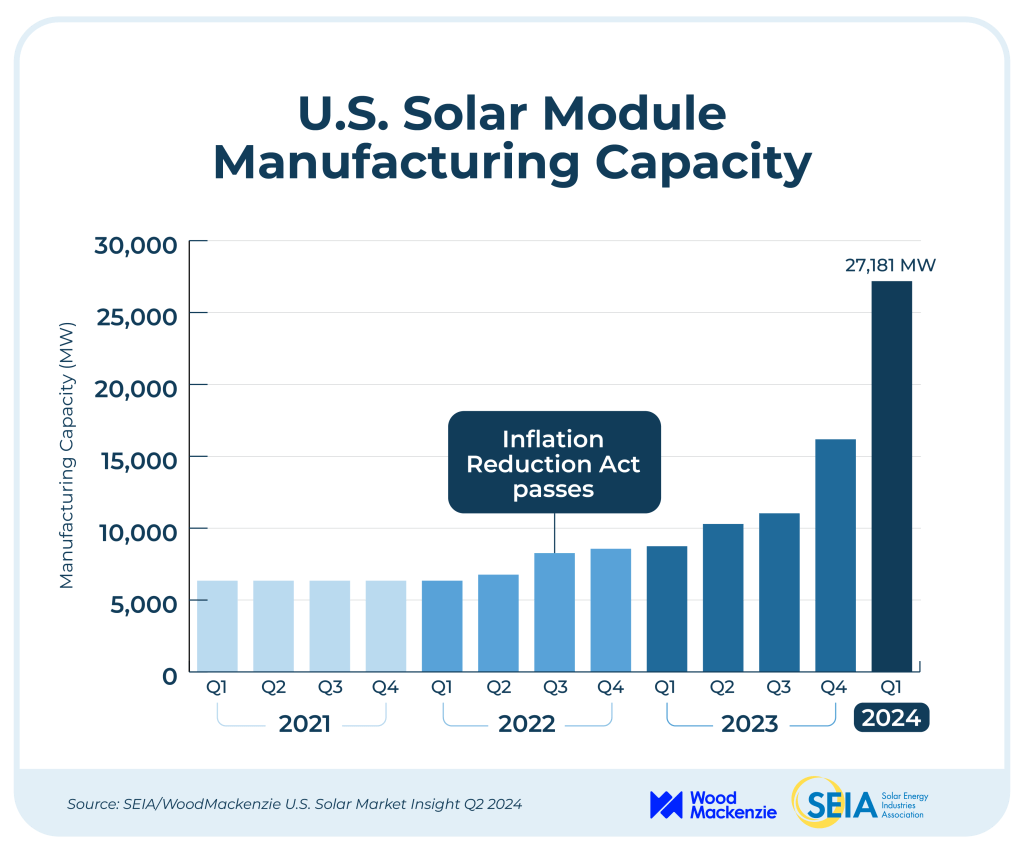
The United States has very rapidly increased its solar panel manufacturing capacity, in large part thanks to financial incentives such as the IRA clean energy tax credits. Credit: SEIA.org
This example proves the intersectionality of President Trump’s energy and America First objectives: smart market incentives improved American energy independence (in this case with solar panels), are leading it down the path to energy dominance (as it continues to climb the panel manufacturing leaderboard), and have helped bring American manufacturing back onshore, placing the nation in a better strategic position for global trade. And of course, without proper permitting reform the panels will not be installed to the necessary scale or time frame needed. Clean energy and American prowess need not be kept separate. Indeed, as this example shows, they can’t be.
Because Chinese solar panels are produced dirtier and with double the carbon emissions of US manufacturers, America First has tremendous benefits for the quality of our air and water. A cleaner America does not need a Green New Deal–it merely needs a pro-American domestic policy.
A cleaner America does not need a Green New Deal–it merely needs a pro-American domestic policy.
– Nuclear Energy –
Nuclear energy is tied within President Trump’s America First objectives more intimately than any other, because America’s technical and manufacturing prowess in this sector carries with it very real national security ramifications. China has 23 nuclear reactors currently under construction, with 55 in operation. The US has only built two this decade, and in stark contrast to its international rival, a dozen nuclear plants have closed instead of been built. Meanwhile, China has added the same amount of nuclear energy capacity in the past 10 years as the United States did in 40.
China is also outpacing the United States in deployment of advanced “Generation IV” reactors, which may eventually be sold to other nations seeking to expand their nuclear energy footprint. This would enable China to control energy production in other countries, something doubly unacceptable when one considers that nuclear energy was born in the United States, which continues to provide the backbone of nuclear energy research.
As the most capital-intensive energy source, nuclear is also intimately wrapped within the need for IRA clean energy tax credit preservation. These credits bridge the critical gap of financial vulnerability in first-of-a-kind technology like Gen IV reactors. They lower cost barriers in tried-and-true Gen III AP1000 reactors as well, on top of 20% cost-savings generated from lessons learned between the construction of the two most recent US reactors, Vogtle Units 3 and 4 in Georgia.
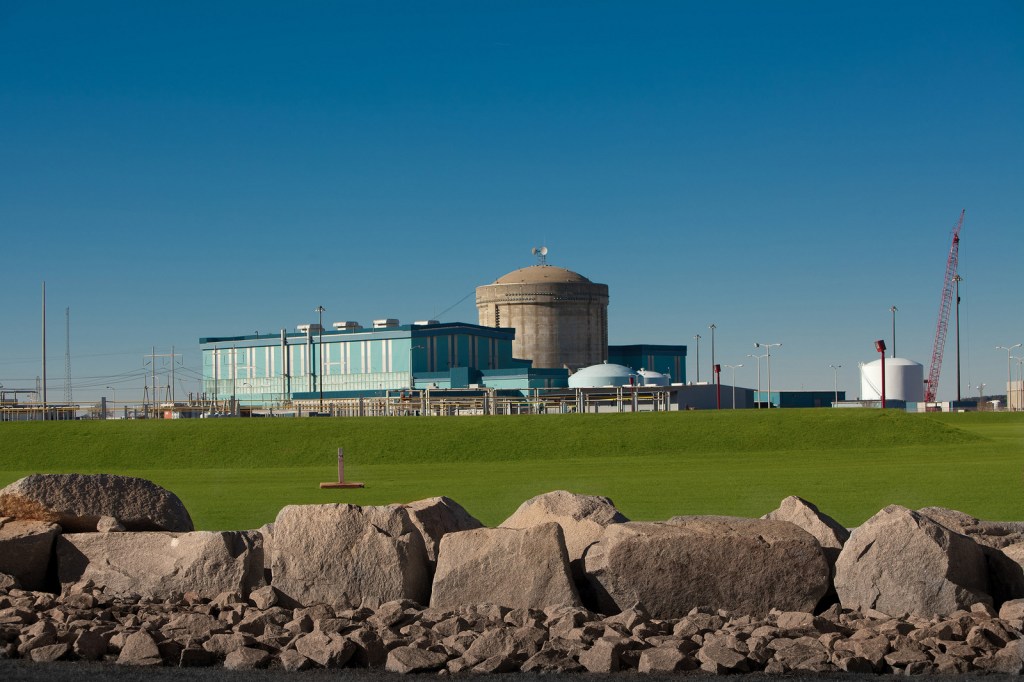
IRA clean energy tax credits will be critical for increasing energy capacity throughout the United States, including the proposed extension of the VC Summer nuclear plant in South Carolina. Credit: Wikipedia
Nuclear energy is undeniably a key energy source needed to fulfill President Trump’s energy dominance goals. Just 94 nuclear plants supply 20% of America’s energy and 50% of its clean energy. Nuclear plants run at exceptionally high standards, provide extremely reliable baseload capacity, and generate power 93% of the time. No other energy source can scale to America’s energy needs as efficiently as nuclear power.
Nuclear simultaneously fulfills President Trump’s America First goals by providing up to 800 jobs per plant at over double the national average wage and $60 billion in GDP. Onshoring nuclear power will provide the United States a leg up in its strategic rivalry with China and unleash a manufacturing and infrastructure boom. As the location of its birthplace, nuclear power is an energy source that the United States should rightfully remain “dominant” in, and it is a technology that can be readily exported to friendly nations.
Conclusion
For too long, the mainstream media has portrayed conservative foreign, fiscal, and domestic policy as irreconcilable with clean, sustainable development. President Trump’s America First energy and domestic goals, which harmonize with the platform of the notable conservative environmental organization American Conservation Coalition Action, prove otherwise. Because the United States possesses some of the cleanest manufacturing processes in the world, achieving clean development is impossible without an America First agenda. When energy and manufacturing are properly incentivized and returned domestically, not only are America’s prestige, economy, and independence enhanced, but its air, water, and natural resources as well.
By Evan Patrohay

 Thoughts of an Environmental Conservative
Leave a comment