
From general revelation and the new creation to imagery in the Psalms, God has made clear the role humans are meant to play in the natural world both here and at Christ’s second coming: one of reflection, stewardship, and active participation in the “liturgy of the land.”
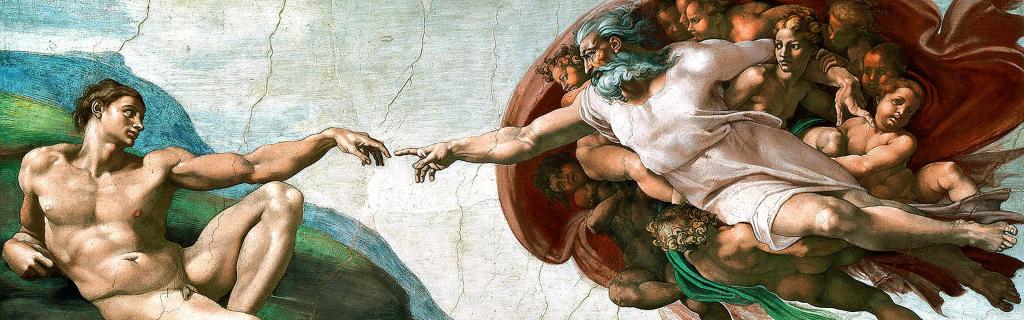
“In the beginning God created the heavens and the earth.”
Over six days God created the morning and evening, the sky and waters, the land and sea, the stars in the night sky, the birds, fish, plants and creatures of all kinds, and at the center of it all, man. While most may read the first chapter of Genesis and marvel at the story of creation, many overlook the awesome responsibilities God directly placed upon Adam for its care. The location mankind was put within the intricacies of the natural world can also inform us how we may best learn from God’s handiwork and function within it today.
Reflection – Omniscience, Majesty, and Sin
The first lesson lies within the famous words “and God saw that it was good.” At the end of each day of creation these words are written as a reminder that the wisdom and omniscience of the creator God was directly imbued into his works. And though the Bible tells us that the fall of mankind tainted the earth and impacted its functioning (Romans 8:18-22), that characteristic wisdom remains unsullied and intact. This wisdom is easily demonstrated by the myriads of intricate complexities that lie within the world’s systems and, especially in the foreground today, its sheer resilience in the face of immense human harm.
Even the smallest ecosystems, such as a typical backyard, are filled with thousands of crisscrossing and overlapping species interactions commonly expressed in what scientists call a food web. The complexity of these webs is further compounded by the influence of abiotic (chemical or physical) interactions upon those species. In fact, scientific evidence suggests that it pleased God to align increasing ecosystem complexity with increasing resilience, through the redundancy of species traits and functions.
And the farther scientists plumb into the depths of these intricate webs, the more complex and interconnected we realize they are. The functioning of our world is the largest jigsaw puzzle of creation whose pieces fit together in seamless beauty. Indeed, not only is every Christian a note in the magnificent symphony of God’s plan, but every bird, every ant, every tree. All this is to remind us that he is God, and we are man.
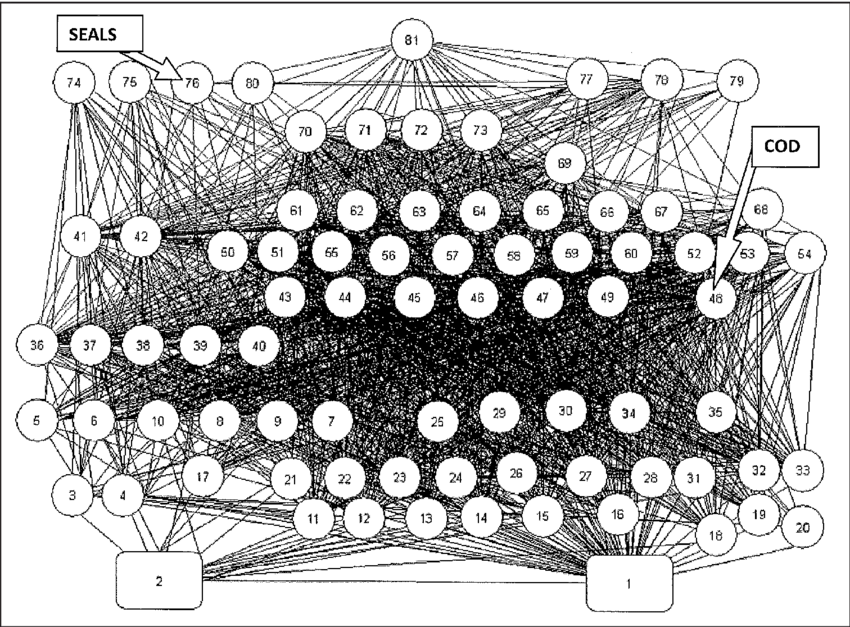
Typical example of a food web from the North Atlantic Ocean (Krebs, 2008). The black lines represent species interactions. Even this web is simplified; there are far more than 81 species (or even functional groups) in the ocean.
These mysteries of creation formulate the idea of general revelation expressed by Paul in Romans, “For since the creation of the world God’s invisible qualities—his eternal power and divine nature—have been clearly seen, being understood from what had been made, so that people are without excuse” (Romans 1:20). No matter where one looks, the sublime complexity of the world is impossible to ignore; complete with natural laws and processes, earthly and extraterrestrial cycles, and systems upon systems—even systems of systems! The practice of conservation allows man to participate directly inside this awesome mystery.
It further pleased God that the forces of nature be used as a reflection and symbol of his power and glory. The divinely inspired Psalms are replete with natural language:
“Blessed is the one…whose delight is in the law of the LORD, and who meditates on his law day and night. That person is like a tree planted by streams of water, which yields its fruit is season and whose leaf does not wither” (Psalm 1:1-3).
“By the word of the LORD the heavens were made, their starry host by the breath of his mouth. He gathers the waters of the sea into jars; he puts the deep into storehouses.” (Psalm 33: 6-7).
And of course,

“The LORD is my shepherd, I shall not want. He makes me lie down in green pastures, he leads me beside quiet waters, he refreshes my soul. He guides me along the right paths for his name’s sake” (Psalm 23:1-3).
God himself directly cites the forces of nature in the beautiful and poetic exposition of his mightiness in answer to the lamentations of Job, which is worth flipping to a Bible and reading in its entirety for full impression:
“Where were you when I laid the earth’s foundation?…Who shut up the sea behind doors when it burst forth from the womb?…Does the rain have a father? Who fathers the drops of dew?” (Job 38:4, 8, 28).
Whole volumes could be written were one to write a commentary on every place a natural symbol or reference is placed in the Bible. The Israelites, who were predominantly shepherds amongst the arid hills and valleys of Israel, would have been intimately familiar with the forces of nature around them. They saw God within these forces and how his majesty cascaded down to the smallest ibis or rooster (Job 38:36). Modern Christians who remain aloof from or unthoughtful about nature risk missing the deeper messages within these passages. Once again, conservation allows each individual to directly witness the natural forces which God has established, and daily participate in them.
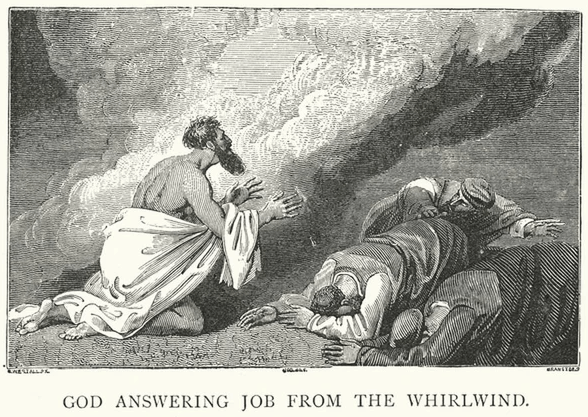
God Answering Job, engraving by Frederick Werne, 1880
Lastly, by bearing witness to the impact of human pollution and harm on the world, mankind can learn deeper insights about the effects of our own sin. The fall of Adam and Eve and mankind’s directive to work the land are directly connected through God’s curse before their expulsion from the Garden of Eden:
“Cursed is the ground because of you; through painful toil you will eat food from it all the days of your life…until you return to the ground, since from it you were taken; for dust you are and to dust you will return” (Genesis 3:17-19).
Though a curse, this passage undeniably connects the act of working the land to the essence of humanity. But more importantly, it is a means of showing Adam his place within the created order (“to work the ground from which he had been taken”) and to show him how reliant he is upon God’s favor (Genesis 3:23). It should also be noted that directly following this banishment the cultivation of the land is seen in a positive light as a way of producing “the fruits of the soil” as an offering to the Lord (Genesis 4:3).
In the already but not yet of Christ’s salvation, the lessons that Adam and his offspring took from the command to cultivate are still applicable to us today, and again will be missed if we are not “working the ground from which we came.”
But the insights our relation to the natural world bring go yet farther. In the modern age, the effects of carbon dioxide and climate change are of chief concern. But in an irony of ironies, carbon dioxide is as directly tied to the essence of humanity as our toil of the ground, for we exhale it with every breath. And so intricately tied to our being is sin, which is fully impossible for man alone to remove.
Other pollutants, such as plastic, which breaks down into ever decreasing size until it quite literally becomes one with individual cells at the microscopic level, or PFAS, which is infamously called a “forever chemical” because of its pervasiveness in living tissue, are yet more signs of the pervasiveness of sin.
No matter what the pollutant is, the scourge of our effects on the world are impossible to avoid and therefore impossible for man alone to fix. And that is the point. It is an undeniable reflection of a fallen world and is meant to turn ourselves outwards and upwards to the return of Christ when all creation will be redeemed.
Stewardship – Dominion with limits
One of the most controversial biblical passages to a modern environmentalist may very well be a divine command given to mankind before the fall:
“Be fruitful and increase in number; fill the earth and subdue it. Rule over the fish in the sea and the birds in the sky and over every living creature that moves on the ground” (Genesis 1:28).
The term dominion today causes discomfort for understandable reasons; the term is highly associated with the colonial and slaveholding past, which none wish to repeat. It is also a phrase highly associated with the Enlightenment period of the 1700s and the 1800s that followed—when quickly improving technologies but a poor understanding of ecology led to widespread environmental tragedies such as rampant deforestation, filthy urban pollution, and numerous species extinctions.
So how could the term “dominion,” especially to a sinful mankind, in actuality mean the responsible stewardship of all things?
Namely, because the command came from God.
Firstly, we would be unwise to ignore the fact that this command is prelapsarian (before the fall of man), when Adam still remained unblemished by sin and in perfect harmony with creation. It therefore came with all the expectations of righteousness. Nor did this command disappear after the fall—God’s curse to Adam and Eve itself retains the command to bear children (Genesis 3:16) and subdue the plants and ground (Genesis 3:17-19).
Moreover, every biblical command to the Patriarchs or Israelites throughout the Bible was always given with moral weight (“be holy, because I am holy”) because they stem from a holy God (Leviticus 11:44-45). Emphasis on the moral weight of God’s commands is likewise repeated in the New Testament and thus apply just as equally to Christians today (1 Peter 1:16).
Therefore, because this command came from a righteous God, we are expected to fulfill the calling of earthly dominion in full righteousness and harmony with creation, a term we call stewardship, or conservation.
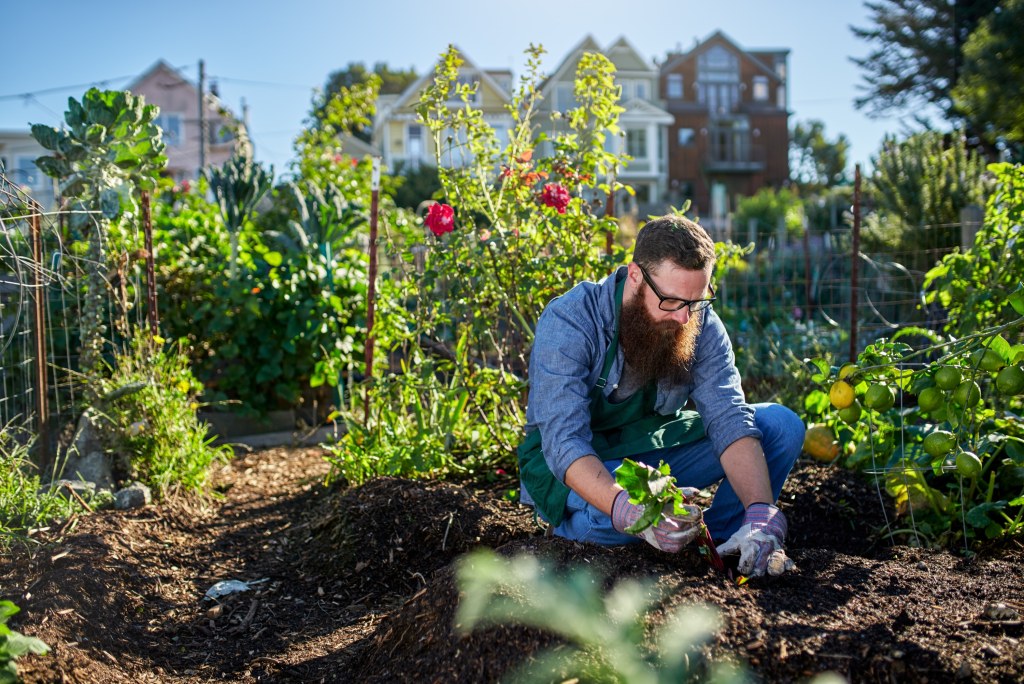
Man practicing homesteading, a form of conservation and stewardship, Shutterstock
But living in full righteousness and harmony with Creation is impossible to a fallen mankind, as is apparent to anyone who has worked the land. But this teaches us perhaps the most important lesson of stewardship: that conservation and cultivation teach us the limits of human beings and how each of us exists at the mercy of forces and immeasurably complex systems that lie far beyond our control. Stewardship, earthly dominion as intended by God, is a practice that relies on him. An arrogant man will not long last in stewardship; he will quickly be humbled.
Active Participation – Furthering the Kingdom of God through the land
The practice of stewardship flows directly into the last biblical lesson in conservation, that we are called to actively participate in the care of Creation through our command to unleash the Kingdom of God upon the earth.
“He said to them, ‘Go into all the world and preach the gospel to all creation’” (Mark 16:15).
In Colossians, Paul states that in Christ, “all things were created: things in heaven and on earth, visible and invisible, whether thrones or powers or rulers or authorities; all things have been created through him and for him” (Colossians 1:16).
Through this we learn that Christ unifies creation, and in Revelation we learn that at his second coming he will redeem it with the new heaven and new earth, the old passing away (Revelation 21:1). In this second heaven and earth the Kingdom of God is to be firmly established and God will dwell among his people. In this age, the “groaning” of the created world will cease and “the creation itself will be liberated from its bondage to decay” (Romans 8:18-22).
But as Christians we are called not just to wait until that time, but to actively spread the Kingdom ourselves in this life.
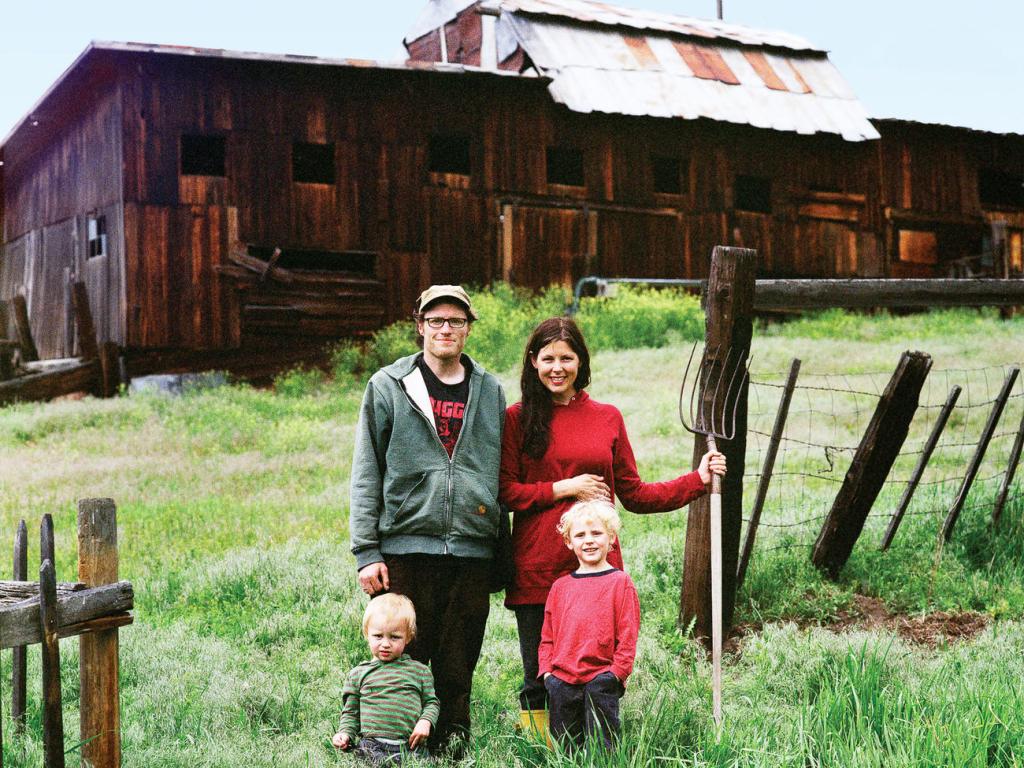

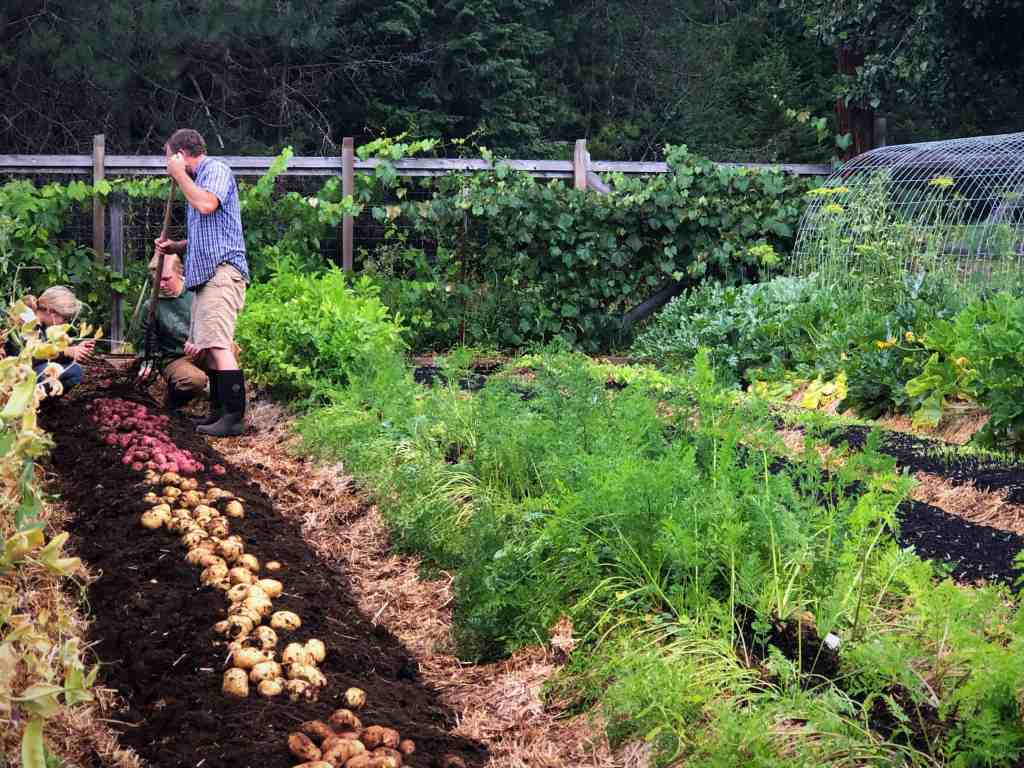
Various families homesteading. From left to right: Moon-Randolph Homestead, Sunset Magazine; homesteadingsimple.com
If, therefore, all creation was made by Christ and for Christ, that the Kingdom of God in some way serves to restore creation, and we are called to spread this Kingdom throughout the world today, then practicing active stewardship as an example of the Kingdom of God, of a harmonious dependence on his blessings and admiration for what he has made, is our calling. This calling is spectacularly exemplified in the book The Liturgy of the Land, which teaches the faithful ways to live and please God in this regard.
The Bible tells us there is life within the Kingdom—life for us and life for what is around us. It is up to Christians and their families today to advance this in humility and spirit, not just to the people in our communities, but to the land they are living on.
By Evan Patrohay
 Thoughts of an Environmental Conservative
Leave a comment